Authors in Indie Blu(e) Anthologies: Kashiana Singh

The Poet – Kashiana Singh.

Kashiana Singh(http://www.kashianasingh.com/) calls herself a work practitioner and embodies the essence of her TEDx talk – Work as Worship into her everyday. Her chapbook Crushed Anthills from Yavanika Press in 2020 is a journey that unravels memory through 10 cities. She proudly serves as a Managing Editor for Poets Reading the News and her voice be read and heard on various international platforms. Kashiana’s first poetry collection is called, Shelling Peanuts and Stringing Words. Her newest full-length collection, Woman by the Door has just been released with Apprentice House Press.

Kashiana Singh – three of her books – including her latest Woman by the Door.

Kashiana’s latest collection of poetry; Woman by the Door is a series of poems that crystallized over the last 9 years, beginning when Kashiana moved from India to the US in 2013. She relates that: “These poems are born of necessity and travel in and out of that doorway into many spaces before and after that point in time. Serving as a problem-solving tool, poetry has continually helped me focus and refocus towards a center of gravity.”

Coming together in this knitted collage are poems rooted in lived experiences and saturated with the poet’s varied sensibilities and influences. The poems flow through three sections – Aperture explores poems of memory and family, Portal opens the door to transition and growth, Detours holds our hand through loss and ache. The woman herself is an intersection, always kneeling by the door – coming, going, waiting, leaning in. Witnessing. Relentlessly she receives and offers lifetimes. Woman by the Door is ultimately preoccupied with paying tribute to that woman.

Country | Kashiana Singh | Samyukta Poetry

Kashiana lives in North Carolina and carries her various geographical homes within her poetry.

Her poems have been published on various platforms including Rattle, Poets Reading the News, Visual Verse, Oddball Magazine, Café Dissensus, and others including anthologies like The Kali Project.  Besides being a learner of poetry, Kashiana’s latest corporate assignment of 16 years was as Vice President, Health and Benefits Operations with Alight Solutions.

Indie Blu(e) talked to Kashiana on the publication of her latest collection of poetry, Woman by the Door – which we were lucky enough to review. Duly impressed by Kashiana’s fluidity of expression and willingness to speak truths, we were reminded of why her work featured powerfully in Indie Blu(e)’s The Kali Project. To say Kashiana can give life to truth, is to underestimate the poised impact of her deftest writing. She is a gentle giant in her approach to poetry and a magnificently astute observer of humanity, not least our interior lives.

What does it mean to bring your background and heritage to your work? How does it influence your writing both in terms of content and language?

“Everything!”

“What I mean by that is that background and heritage is not just a guest participant but fully immersed within the poems through their inspiration, source, language, music or form. Each/All of these elements stay in gestation till the final piece takes birth and are ingredients that add fragrance to our work. The tapestry we stitch together is richer when suffused with elements of stories, sounds and shapes of buzzing words and drunken language.”

Singh is always in search of new beginnings as she distills deeper into her core as a poet-practitioner… The book is a ‘portal’ that summons and reveals, it offers a quiet introspection of memory as well as is vulnerable in it’s discourse with loss, each poem a witness to the spirit.

The process of navigating through these poems gave me both the permission and the fortitude to remember and transmit aspects of my own background, my journey as a woman and as a global observer of dailyness. As is often stated and recently reinforced by Nobel Prize winner Gurnah: “writers come to writing through reading,” I firmly believe that writers come to writing with their heritage and history.”

In an interview with THE POET Kashiana made the following observation of how her cultural and ethnic and spiritual identity ties together:

“I am a Sikh and it is part of my lexicon without necessarily ever thinking about it. The Guru Granth Saheb, which is the holy scripture of the Sikhs, is really a compilation of approx. 4000 hymns, that are both exhilarating and uplifting. Second, I have had an ever-present influence of Sikh values – speaking for the truth, a keen awareness of the larger order, and work as worship. So, in that context I would say Sikhism does factor in organically into my writing in terms of the traditions of both oral and written forms of poetry, and the philosophical attributes of being a Sikh.”

“I am a fusion of all my sensibilities and geographies. The language and words I bring into my poems come from all the places that I have directly and indirectly been influenced by, and is inherent to my poetic refrain. I say that my poems help me continually focus and refocus towards a center of gravity.”

“I cannot ignore my skin color, my accent, nor my Indian descent, but I think of all of these as enablers to my poetic output. I bring to my writing table a larger canvas and a broader range of perspectives and some days that is an advantage and other days a burden but never something I can ignore. I think Ada Limon said it best in one of her interviews that we are like a ‘collage‘ – that is beautifully stated.”

(For the full interview please visit Kashiana’s Q&A with THE POET HERE. )

Kashiana Singh speaks about her book Woman by the Door on Wedneday Night Poetry (Kai Coggin) HERE: : https://www.facebook.com/535429421/videos/317120953704473/

Here is Kashiana Singh reading her poem Miracles, which was featured in Rattle. She’s a natural reader and has great clarity in her natural reading. https://www.rattle.com/miracles-by-kashiana-singh/

Website: http://www.kashianasingh.com

Instagram – @kashianasingh

Twitter – @Kashianasingh

Facebook – https://www.facebook.com/authorkashianasingh

Kashiana Singh – Worship as a Work Practitioner / TEDx talk.

Indie Blu(e) Publishing is extremely proud to showcase and highlight our anthology contributors including superb world poets like Kashiana Singh. Her accomplishments may speak for themselves but sharing her work and passion reminds us why we put together anthologies and the joy of working with multi-talented poets and artists throughout the world. http://www.indieblu.net To read Kashiana’s valuable poetic contribution in Indie Blu(e)’s The Kali Project – get your copy via Amazon HERE or any good bookseller.

You can purchase Woman by the Door on Amazon and most booksellers HERE as well as Shelling Peanuts & Stringing Words HERE and

Authors in Indie Blu(e) Anthologies: Nadia Garofalo

With Relative Traumas Nadia Garofalo has taken her gift as a song-writer and poet, and merged the two together to create a striking collection. One of the most exciting projects I have worked on lately, due to the passionate truth of Garofalo’s writing, which Indie Blu(e) Publishing first discovered through our anthology SMITTEN.

Nadia Garofalo is a childhood friend of Indie Blu(e)’s author Georgia Park and when she submitted to SMITTEN (purchase HERE) we recognized that unique blend of songwriting ability and wordsmithing. We were so impressed with Nadia’s writing and her being an accomplished musician and human-being. 

Singer, songwriter, musician, and poet Nadia Garofalo is a throwback to the days of Byron and all who felt deeply, intensely, piercingly. As a songwriter, Garofalo has the precision of a wordsmith – she knows how to infiltrate the soul and will rend your emotions with her refrain. This debut collection of poetry examines the exquisite pain of chasing your dreams throughout the years, and storing within your blood the urgent need to live passionately. Her writing is raw, edgy, and unapologetic, with a tendency to revive the reader in the way that one is revived by putting their hands in cool water.

When you consider your life, imagining the ancestors before you who immigrated and brought their cultures with them, you forge memories without end. Garofalo condenses these types of observations alongside the humming piques of desire and complex relationships. Her confessional words might as well be sung for all the power they possess, imploring to the void for more. There is such a stirring rendition of urgent living here that it quickens the pulse, stirs what was once thought long dead, and awakens us to the potency that is poetry.

  • When did you first realize you wanted to be a musician and given that it’s a challenging job, did you think it would actually happen? 

    NG: I’ve tried to quit music a few times over the years but it just never seems to stick, there’s always something that brings me back. I think being in a band in high school, independent of any structural/school-related activity, was the first time I thought of it as any kind of future pursuit. Like maybe I’ll continue to play music with friends as a hobby and write my own songs when I feel like it etc.
  • What part does writing play in your role as a songwriter and musician? What is your process and if you don’t have one, how do you start and finish writing something you are happy with? 

    NG: Writing is the center of pretty much everything for me, it’s how I work out concepts and feelings in a way that makes sense to me. I’m much more naturally a writer than a musician so sometimes the rhythm of words can feel almost instrumental to me, it can inform the instrumentation just as much as the other way around.
  • How hard it is to get in front of a huge audience? What do you do to get through that and make it work? 

    NG: I’m a clinically anxious person but for some reason, I can feel completely comfortable performing with Ganser in front of a large audience, it’s like a switch goes off in my head and I just do “my job”. Its a lot more difficult for me to read poetry on my own, it’s just a much more intimate experience for me. In both situations, I do my best to keep my head clear and avoid anything that might make things harder for me by taking care of my mind and body as much as possible leading up to a performance. If I’m nervous I’ll give myself some time to write it out or take space to breathe. 
  • When you decided to put your poems together, what were you thinking in terms of the direction you wanted to take this? Did you have any concerns? 

    NG: I’ve been passing the idea of publishing a chapbook around in my head for a few years but 2020 was when I actually started the process of convincing myself to do it. It took another year or so of going through my notebooks to pick out and edit what I wanted to include. In terms of the direction, I wanted to give space and attention to what I was going through while those notebooks were being filled but with a perspective gained from looking back at it years later. It’s scary because it can feel very vulnerable to have these things out there for public consumption, I was always concerned it wouldn’t be good enough but that’s something I’m working on. 
  • Is publishing your poetry a different feeling than singing/songwriting and if so, how is it a different experience? 

    NG:  I was lucky to have a lot of support in making this book but at the end of the day it’s just me out there with my name on this thing I made. One of the things I love about songwriting is the collaboration that happens between me and my bandmates, we are all working towards the same goal of making music we can all be proud of. With writing (especially self-publishing)  I’m the one who has the definitive say in what the final product is and that can be great but also scary. 
  • What was your vision with Relative Traumas? What influenced you in terms of the layout and design? 

    NG: I wanted to create a book that felt as intimate as the material inside. I used the City Lights Pocket Poet series as a model for how I wanted my book to look, I love that you can carry them with you easily where ever you go. My earliest memories of poetry always had some element of illustration so I wanted to pay homage to that as well as bring in the work of some of my favorite local artists to accompany the poems and not completely lose the collaborative element in this “solo project”.

Nadia wasn’t sure if her first book was really something she should do. She’s a successful prop designer and buyer and has a cool life in Chicago with their flourishing music scene, hell she opened for The Smashing Pumpkins … it doesn’t get much better. But despite these successes she’s a very laid-back, humble and non-grandiose human and she was in two-minds about dipping her toe fully into a whole book of her own writing.

Despite this – she went ahead and Relative Traumas was born. A physically small book, it stands out as a pocket-sized collection of art and words – a little like the miniature Penguin editions, and the care and design put into it is very original and unique. Nadia somehow had time to create this alongside her full time job as a Pops Buyer in Chicago and touring with her successful band. 

Her debut collection, Relative Traumas is a true testimony to Nadia’s pure ability as a writer of songs and poetry and life. She may not yet know how good she is (which is a bit adorable, in this world of unfettered egotism) but anyone who has read her, surely does. Indie Blu(e) loves that the world still have some living-breathing-true musicians who get on the road and do the grind. That those musicians have poetry in them and despite the knock-down-drag-out spectacle of life, continue to write that poetry. We hope we never grow tired of those kinds of souls, let’s always harken to the dark birds of song and post-punk revelry. 

Relative Traumas is available via Amazon HERE and by asking your independent bookstore. You can also buy it direct from the author. If you love indie poets and musicians, song-writers and incredible musicians then Nadia Garofalo’s debut Relative Traumas is going to sate that hunger.

Social Media Links: 

Medium Page

@Nadic on Instagram

Here’s a video of the band Nadia is in – Ganser (https://www.ganserband.com/)

Authors in Indie Blu(e) Anthologies: Somrita Urni Ganguly

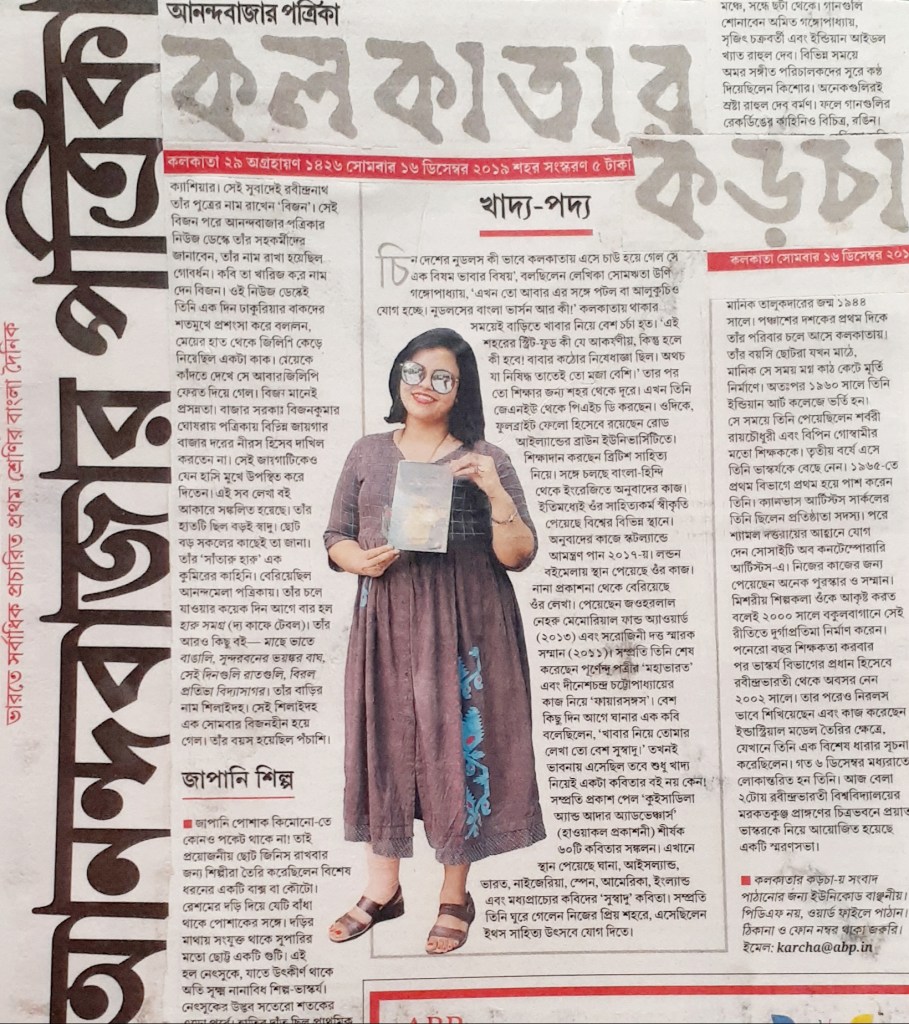
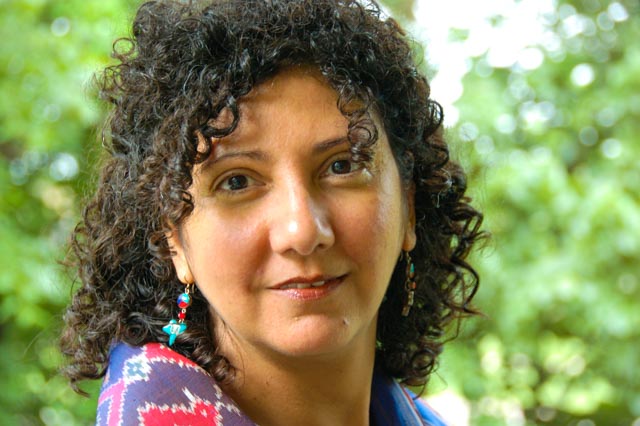
It can be a daunting task to work with such talented writers/poets as Indie Blu(e) Publishing has had the fortune of working with. Somrita Urni Ganguly is no exception. We met via The Kali Project and have followed her work since. She is literally an explosion of talent and energy and the very best slam-poetry live speaker we’ve seen in a very long time. Somrita’s boundless energy and enthusiasm is infectious and a beautiful thing to witness. She truly loves what she does and that’s probably one of many reasons she’s so good at everything she turns her hand to.

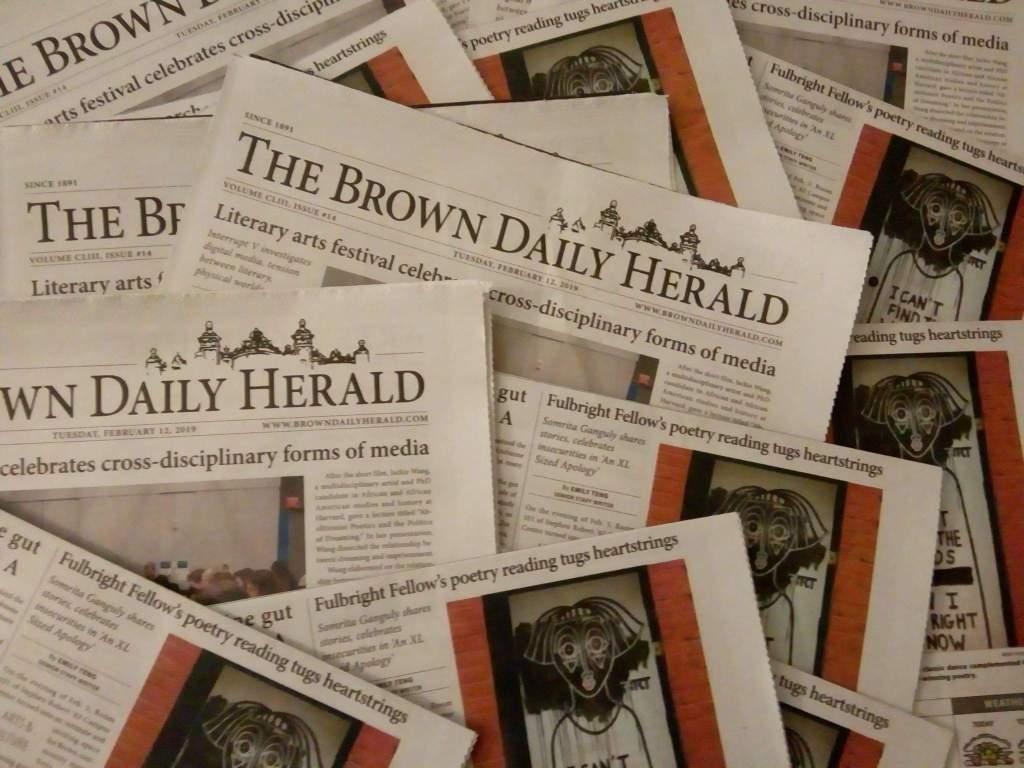
Somrita Urni Ganguly is a professor, poet and literary translator. She was a Fulbright Doctoral Research Fellow at Brown University, and is an alumna of the University of East Anglia’s International Literary Translation and Creative Writing Summer School. She served as a judge for the PEN America Translation Prize, and an Expert Reader for the English PEN Translation Grant, the National Translation Award (USA), and the National Endowment for the Arts Translation Grant offered by the US federal government.

Somrita is currently Head of the Department of English, Maharaja Manindra Chandra College, University of Calcutta, and has co-founded The Writing Programme in India. Her work has been showcased at the London Book Fair and she has read in cities like Bloomington, Bombay, Boston, Calcutta, Cove, Delhi, Hyderabad, Miami, and Providence. There is something powerful to witness Somrita reading a poem. It’s beyond the brilliance of the writing, she throws her entire spirit into reading, she has the whole room enraptured by her passion for the subject and it’s an experience like a concert, not just a reading.

Somrita has delivered lectures and presented her work at several institutes around the world including the University of Pennsylvania, Princeton University, the National University of Singapore, Bath Spa University, the Emily Dickinson Museum at Amherst, the American Literary Translators Association, the Oregon Society of Translators and Interpreters, and the University of Nottingham. This comes as no surprise. She literally has her finger on the pulse of what matters to young, educated, intelligent Indian women and women throughout the world. On subjects of skin color, body, sexual freedom, and sexual assault, she speaks loudly without apology, and with great truth.

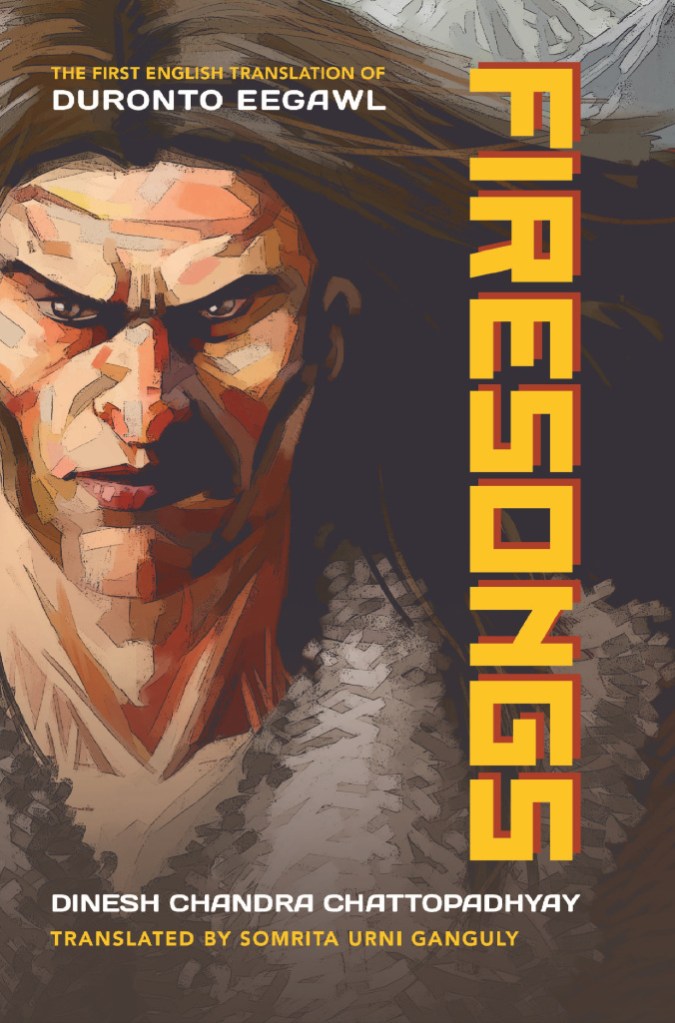
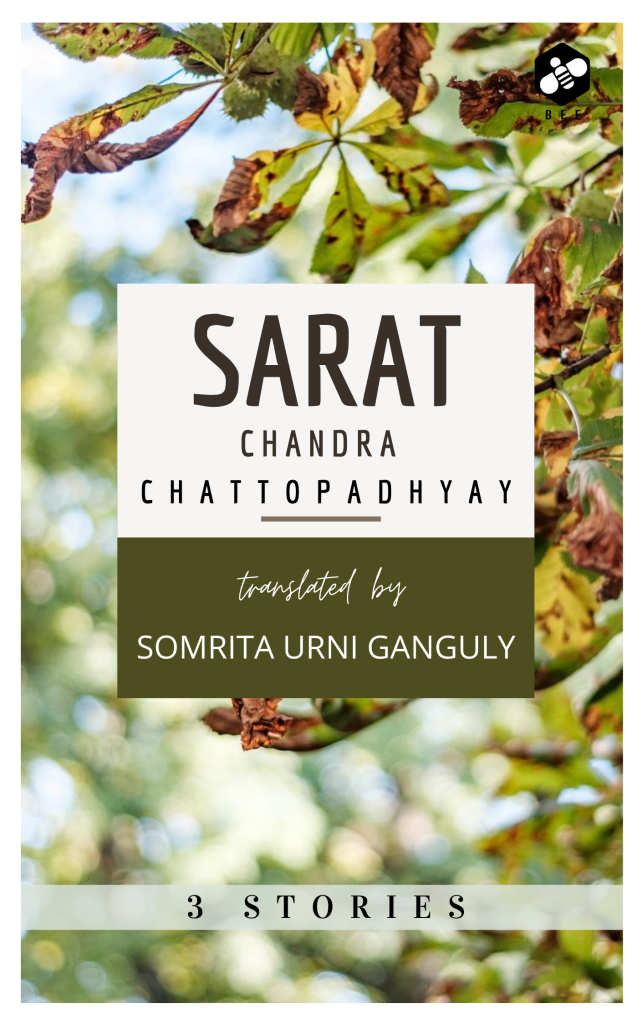
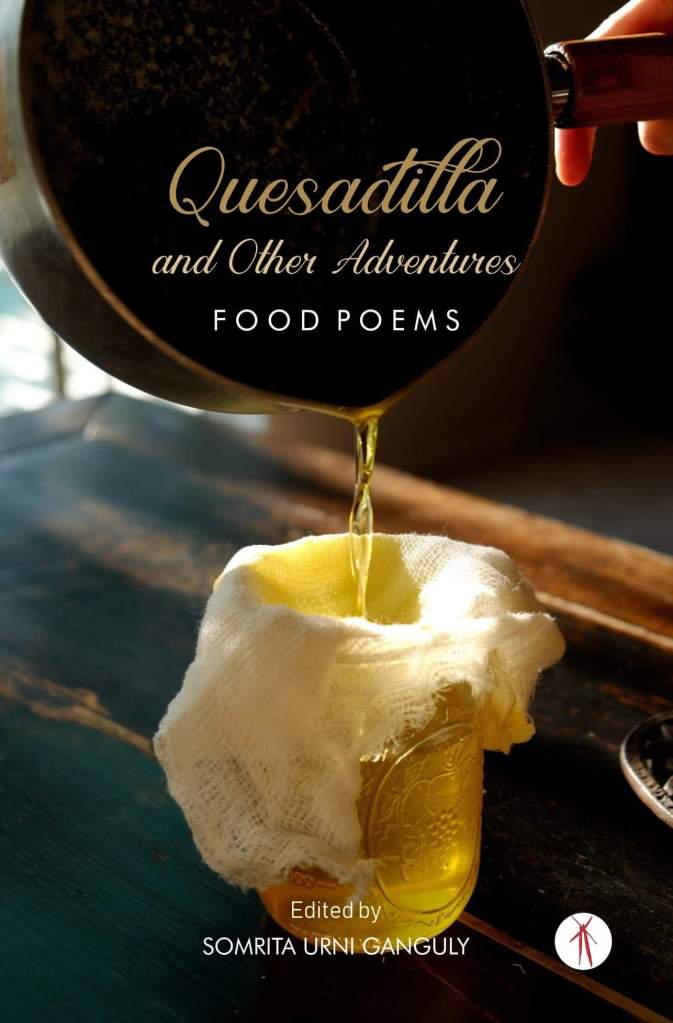
Somrita edited the first anthology of food poems, Quesadilla and Other Adventures (2019), and translated 3 Stories: Sarat Chandra Chattopadhyay (2021), Firesongs (2019), Shakuni (2019), and The Midnight Sun: Love Lyrics and Farewell Songs (2018), among other works. She is a recipient of the Jawaharlal Nehru Memorial Fund Award and the Sarojini Dutta Memorial Prize. No surprise there, she’s teaming with good ideas and enthusiasm for her next project, it’s incredible she does so much, and still has time to deliver some of the most provocative, honest and intense readings yet:


Somrita says: “Words are my way of processing emotions: hurt, anger, love, pain, trauma; and of making sense of the world when things seem to be falling apart. I am a voracious reader, but I am not a disciplined writer; that is to say, I do not meticulously write a sonnet every fortnight, or haiku on changing seasons every year. I write when I can no longer hold the words in me, when I’m choking on them, when they come rushing out of me: ink bleeding on paper. “

“I am currently working on four wildly different literary translation projects: one is a brief history of the print industry in Darjeeling; the second is a work of historical fiction on the Nobel Laureate Rabindranath Tagore’s mother, the third is a gangster-novel-meets-Jack-Kerouac, and the fourth a Bangla graphic novel.”

(Somehow! Despite working full time as well!) “I also put together an anthology of poems about places, people, homecoming, and home-leaving that I wrote over the last five years. It’s called The Architecture of Dreams, and I am now, somewhat hesitantly, embarking on the arduous but fulfilling journey of looking for a publisher for this work.” if you’re reading this and you know of a publisher who appreciates brilliance, you might want to let them know about Somrita. Translation is no easy thing; Somrita translates from Bangla and Hindi to English. She was selected by the National Centre for Writing, UK, as an emerging translator in 2016, and invited as translator-in-residence at Cove Park, Scotland, UK.

When Candice Louisa Daquin of Indie Blu(e) Publishing and Megha Sood, worked with Somrita Urni Ganguly on The Kali Project, they were both blown away by her sincerity and desire to change the world positively. Covers of books are always debatable, and as a valued contributor to the anthology, Somrita contacted the editors with questions about how Kali had been depicted. We discussed it at length until all parties were assured we were not attempting to be disrespectful.

Indie Blu(e) is founded on the promotion of minority rights, and stands for equality and integrity. But Somrita didn’t know us then and she had the moral courage to ask us directly which we think says a lot about her generation and her commitment to being an ethical and good human being. After all, if we questioned things more often instead of letting them slide, we wouldn’t have some of the issues we have today – would we? This alone marks Somrita Urni Ganguly as a person of worth and integrity, and that’s without considering how talented she is in everything she turns her hand to.

Matla Nodi

There is a river in Canning, called
Matla (n., meaning: intoxicated/ the first couplet in a ghazal).
I would like to be her, someday:

a drunk roaring raging raving poem of a river

Our rivers never get judged.

All the online videos of Somrita’s LIVE readings are HERE and she’s just a BRILLIANT live poetry reader so please if you do one thing today give her a listen. You will be very glad you did!

Links to your work published online: Read: https://somritaurniganguly.wordpress.com/read-2/Shop: https://www.amazon.in/Books-Somrita-Urni-Ganguly/
Your website: https://somritaurniganguly.wordpress.com/

3 Stories – Sarat Chandra Chattopadhyay (2021) | 
Quesadilla and Other Adventures: Food Poems (2019)

Any social media links:Facebook: www.facebook.com/urni.g
Instagram: @blessed.damsel ( www.instagram.com/blessed.damsel/ )Twitter: @blessed_damsel ( https://twitter.com/blessed_damsel )YouTube: www.youtube.com/user/theunputdownable
LinkedIn: https://in.linkedin.com/in/somrita-ganguly-86bba2180

Indie Blu(e) Publishing is VERY proud of our authors / poets / artists and contributors to our anthologies. We love highlighting their accomplishments. If YOU are a IB contributor and wish to have a profile here, please get in touch (indleblusubmissions@gmail.com) including information we’d like to promote on our website such as: Bio, photo, live readings, links, interesting information and one short exert or poem. http://www.indieblu.netHERE.

Authors in Indie Blu(e) Anthologies: Zilka Joseph

Zilka Joseph and Indie Blu(e) Publishing met through Indie’s The Kali Project, which Zilka submitted poems for. We were very fortunate to have poetry by Zilka in this collection, she is a particularly addictive poet with a keen artistic eye and someone not afraid to write out truths.

Indie Blu(e) caught up with Zilka Joseph, who is always creatively busy writing books and submitting successfully to anthologies or editing others’ works. She shared with us: “I am fortunate to be be part of two projects sponsored by Michigan State University–two of my poems will appear in an anthology on “Home” and are on the shortlist offered to filmmakers for the Filmetry Festival, where film makers choose a poem and make a film to enter the contest. At the moment, I am writing poems inspired by creation hymns from the Rig Veda that will become an audiovisual component for an Odissi dance production/video.” These are incredible multi-layered, exciting projects with the medium of film utilizing poetry, which sounds like it’s becoming an ever-popular genre in its own right.

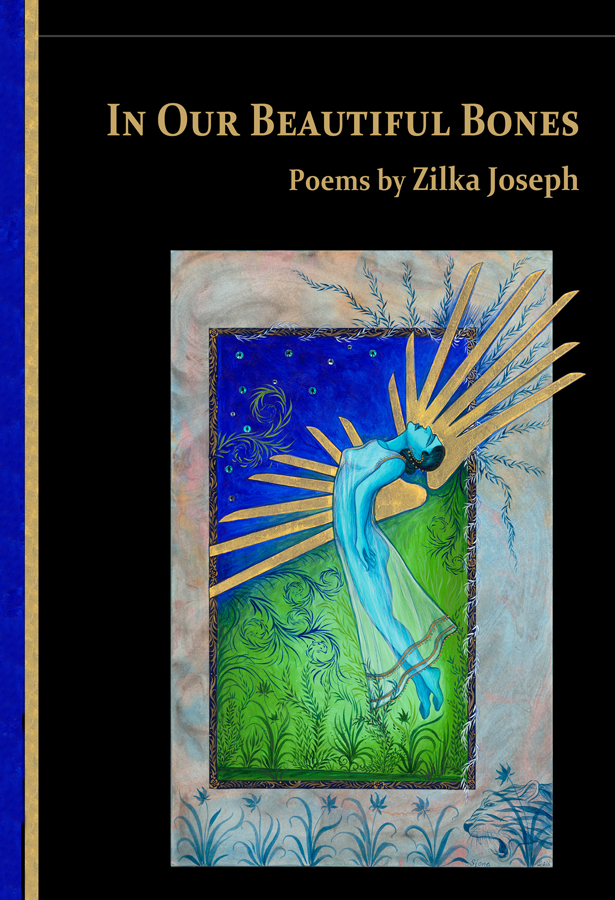
“Later this year, I hope to collaborate on some projects with artist Siona Benjamin, (who, like me, is from the Bene Israel community), whose themes of immigration and myth resonate with my work. Her art is on the cover of my book In Our Beautiful Bones.” When Indie Blu(e) first saw Zilka Joseph’s cover, we were similarly impressed at the extreme beauty of this cover art, which compliments the stunning writing therein.

Zilka Joseph reading from her new book IN OUR BEAUTIFUL BONES – on Rattlecast 131.
Joseph’s incredible poetry collection with jaw-droppingly beautiful cover art.

Here is Zilka Joseph reading from her collection – In Our Beautiful Bones, at her book launch at Literati Bookstore, Ann Arbor, MI. October 6, 2021. Here she is reading with Nawaaz Ahmed and NN Carlson.

Zilka Joseph was born in Mumbai, and lived in Kolkata. Her work is influenced by Indian and Western cultures, and her Bene Israel roots. In the India she grew up in, communities of all religions and faiths lived side by side, went to school together, celebrated festivals together, and were quite integrated. It was natural for her to absorb  Indian and Western cultures and literatures, in addition to her own Indian Jewish culture, and read writers such as Tagore, Nissim Ezekiel, Kamala Das. Her work reflects a range of subject matter and complexity.

She shares with us some information about this unique community she belongs to:

“There are many theories about the origins of the Bene Israel, (called “Shanwar Telis” or Saturday oil pressers) from India. The three most well-known ones are (1) they arrived after the destruction of temple by the Romans in 70 C.E., (2) that they were the descendants of the Lost Tribes, who came around the time of King Solomon in the tenth century B.C.E., and another one says that they were fleeing from Galilee and the rule of the Greek overlord Antiochus Epiphanes, in 175 B.C.E. Some scholars seem to think it was more likely that they came in the fifth or sixth century C.E. from Yemen or South Arabia or Persia. (Sources: The Jews of India by Benjamin J. Israel Mosaic Books, and The Bene Israel of India: Some Studies by Benjamin J. Israel, Orient Longman.).”

“Probably the most popular theory about their arrival is that two ships were shipwrecked on the west coast of India in 175 B.C.E., and it is said that they were fleeing from Galilee and the rule of the Greek overlord Antiochus Epiphanes. The survivors settled in villages, and made a new life for themselves. They adopted Indian ways, clothes, foods, and kept the Sabbath.”

“Their descendants have thrived in India and wherever in the world they immigrated, contributed to the greater good and to society, and made their mark in varied professions.”

Zilka has a BA in English and a BEd (a post-graduate teaching degree), from the University of Calcutta, India and an MA in Comparative Literature from Jadavpur University, Calcutta. India. She was a high school English teacher at St. James’ School for Boys, Kolkata. She moved to Chicago with her husband later in life, where she began volunteering at a public school and the Indo American Center. She attended several literary festivals, read contemporary American literature, and was inspired by the writers and poets she read and met. After she moved to Michigan, she began taking writing workshops, attending conferences, and publishing her work.  

She has been nominated several times for PEN, Pushcart, and for a Best of the Net awards, participated in literary festivals, readings, interdisciplinary collaborations, been featured on NPR/Michigan Radio, Rattlecast, podcasts such as Desi Books, Culturico, CEW’s Strength in the Midst of Change— Center for the Education of Women, University of Michigan, and other audio and online interviews.

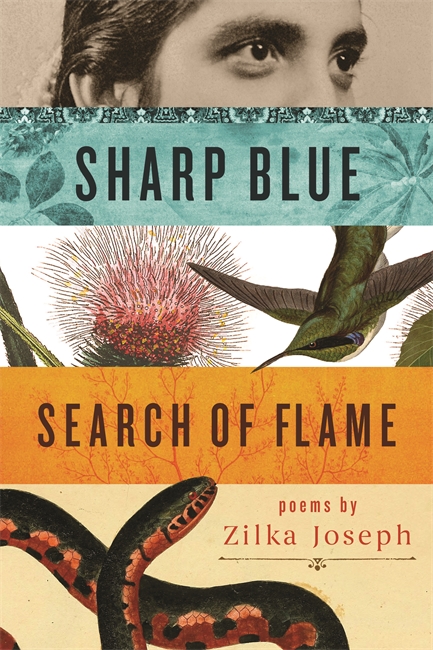
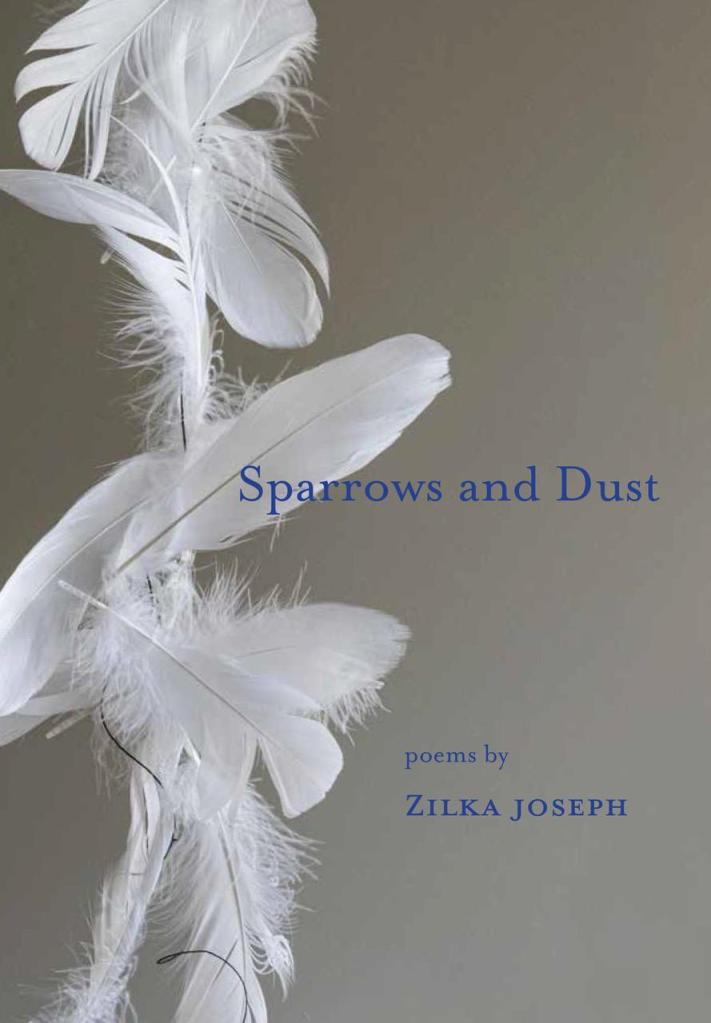
Published internationally, her work has appeared in journals such as Poetry, Poetry Daily, Frontier Poetry, Kenyon Review Online, Michigan Quarterly Review, Rattle, Asia Literary Review, The Writer’s Chronicle (AWP), The Punch Magazine, Poetry at Sangam, Review Americana, and in anthologies such as 101 Jewish Poems for the Third Millennium, The Kali Project, RESPECT: An Anthology of Detroit Music Poetry. Sharp Blue Search of Flame, her book of poems, was a Foreword Indies Book Award finalist. Her third chapbook Sparrows and Dust won a Best Indie Book Award and was a New and Notable Asian American Poetry Book (Lantern Review).  

In Our Beautiful Bones, her newest book, has been nominated for a PEN America and Pushcart prize.  She was awarded a Zell Fellowship, the Michael R. Gutterman award for poetry, and the Elsie Choy Lee Scholarship (Center for the Education of Women) from the University of Michigan.

Zilka Joseph teaches creative writing workshops in Ann Arbor, Michigan, and is an editor, a manuscript coach, and a mentor to her students. http://www.zilkajoseph.com

Zilka Joseph’s prolific talent and stunning cover art – stands out yet again with her collection Sharp Blue Search of Flame.

You can also click on this link and see Zilka Joseph reading from In Our Beautiful Bones, for Third Wednesday Magazine: The Living Room Online Literary Series hosted by ML Liebler: Reading with Kirun Kapur, Sumita Chakraborty and Indran Amirthanayagam.

Sparrows and Dust

I believe! I believe!—

In the sparrow, happy on gravel;

—From Roethke’s Praise to the End!

The first time I noticed a cloud of dust rise

from the playground, I squinted my six-year-old eyes

and saw sparrows flailing about

in gravelly dirt. My mother told me, Look, they’re having

their daily dust bath! See how well they wash themselves.

Such a cleansing! Dust with dust, letting what’s broken, biting,

or dead flake off. I have always loved house sparrows even

when they drove us mad with their noisy fights and ferocious

nesting inside our second-floor Kolkata flat. Raining dirt,

twigs, eggs and just-born chicks on us when rival pairs fought

for territory on tops of cupboards, chinks in clutter and junk

stored everywhere. Our house was heaven, and a kind

of hell. Sometimes when streaking in from the hot sun,

one would fly into the fan’s spinning blades. With a soft

gasp, it would die at my feet.

Sometimes, how it struggled, poor thing, I would cradle

its head as blood seeped into my hand, give it water, whisper

comfort. Often, when I shut its eyelids, a vision of my own

feathered body lying lifeless below

would flash by, as I hovered above. As if

I have been somewhere else. Weeping, I willed them—

Come back from the dead. Failed shaman, I never saved anyone

or anything—my parents, the animals and birds

we loved, the locked flat fallen to ruin. Now, years later,

in short Michigan summers, I look for flusters of dust,

feel a warmth thrill in my aching bones when I see

the happy birds squirm in soil, then spring from a cloud, fluffing,

cheeping, cleansed, whole. I think of the little-known tale I read—

about the precocious, five-year-old trickster Jesus who played

by the river one Shabbath evening, and who shaped twelve

sparrows from wet clay. When his father scolded

that he had violated the holy day, Jesus clapped, shouting

to the birds to “remember me, you who are now alive,”

and the living sparrows

rose and flew away.

Zilka Joseph’s Notable Indie Book Award Winner – Sparrows & Dust – poems.

Sparrows and Dust, Notable Indie Book Award Winner, 2021. Book launch at Literati, with poets Robert Fanning and John Freeman:

​You can also click on this link and watch Zilka Joseph reading at Stony Brook University, Matwaala South Asian Diaspora Poetry Festival, 2020. She is reading with Pramila Venkateswaran, Monica Ferrell, Usha Akella and Sophia Naz. Both Venkateswaran, Akella and Naz were fellow writers in The Kali Project.

https://www.stonybrook.edu/commcms/wang/events/#matwaala

“My new manuscript of poems is currently in circulation. I continue to teach poetry workshops via email, and coach clients via Zoom and Facetime. Critiquing book manuscripts, guiding writers on their journey to publication, and working with students/clients to help them get to the next level, whether it be for an MFA, or to publish a poem for the very first time, is what makes my calling worthwhile. What gives me the most joy is to witness their joy when they accomplish something they set out to do, and when the manuscripts I helped them hone get published!”

Indie Blu(e) Publishing is VERY proud of our authors / poets / artists and contributors to our anthologies. We love highlighting their accomplishments. If YOU are a IB contributor and wish to have a profile here, please get in touch (indleblusubmissions@gmail.com) including information we’d like to promote on our website such as: Bio, photo, live readings, links, interesting information and one short excerpt or poem. http://www.indieblu.net HERE.

Authors in Indie Blu(e) Anthologies: Antonio Vallone

We’d very much like to highlight poet, editor and professor, Antonio Vallone whose work was featured in Indie Blu(e)’s But You Don’t Look Sick anthology last year. Vallone’s work impressed the editors so much we nominated him for a Pushcart. When you read Vallone’s work you’ll see why this wasn’t a hard decision but a natural one.

Maybe his years as an educator, and editor, or perhaps a combination of natural talent and life experience, have lent Vallone’s work a brevity and succinct emotionality that cuts right to the core of subjects. It takes a lot for a poem to grow those kinds of roots but much of Vallone’s work has that gravitas and unflinching insight into the human condition. How perfect for an anthology discussing invisible physical illness? Though we are certain, Vallone can write on any subject with the same intoxication in his approach. It’s no wonder this poet is a beloved academic for so many years as well as founding publisher of MAMMOTH books (created while a student at SUNY Brockport).

Antonio Vallone studied at Monroe Community College (AS), SUNY Brockport (BS and MA) and received his MFA from Indiana University. He also has PhD coursework from Purdue. No wonder then, Vallone has spent many years as a treasured Associate Professor of English at Penn State DuBois.

Vallone is also the poetry editor of Pennsylvania English and the co-founding publisher and editor of The Watershed Journal Literary Group—which provide, for Pennsylvania Wilds-area writers, journal publishing opportunities through The Watershed Journal, a quarterly literary magazine, book publishing opportunities, and runs Watershed Books, a literary arts center and used bookstore.  Vallone is a board member of The Watershed Journal and the Pennsylvania College English Association. 

Vallone’s Poetry collections include: The Blackbird’s Applause, Grass Saxophones, Golden Carp, and Chinese Bats. Forthcoming: American Zen and Blackberry Alleys: Collected Poems and Prose. In progress: The Death of Nostalgia. 

The Education of Frederick Douglass

At twelve, enslaved,

Frederick Douglass read,

he said, to be saved,

and so he didn’t feel

like a slave.

__________

The ancient men whose works he read

wrote he was a living being

who shouldn’t be oppressed.

His mind was liberated then,

free, like his body should be.

When we discussed poetry with Vallone he shared that: “The potential for poetry exists everywhere around us. Since I’ve had a cancerous kidney (and two toes as a bonus) removed and now need dialysis three times a week for four hours a session every week for the rest of my life, I’ve written and published several poems about those experiences. At the same time, I’ve looked out my front and back porches and have seen turkeys and ducks I’ve written and published poems about, as well as a friend’s experience with bringing a hummingbird out of torpor.”

“(it is for these reasons in part) I feel like a hairier version of Snow White, except poems land on my outstretched fingertips instead of birds. I think everyone, if they opened themselves up to poetry, could be the same way. Poetry, after all, can be about everything. It’s in the air around us.”

With such a positive perspective on writing poetry, no wonder Vallone has impacted so many people’s lives despite his own health set-backs. He stands as an inspirational writer for those coming up through the ranks as well as his contemporaries and people who have fought serious illness and still want to retain their creativity. Indie Blu(e) was honored to publish Vallone’s work in our anthology on invisible physical illness. It is one of the best aspects of our job, to meet talent like Antonio Vallone and share his work with others.

A lovely story about Antonio’s name: His given name is Antonio. “When I turned 16 and got my driver’s license, I listed my name as Anthony. (My grandfather who lived in the US and my uncle both used Anthony instead of Antonio–since it was more common). And I–a stupid 16-year-old– didn’t want to seem “different.” When I started publishing, I wanted to honor both my grandfathers, so I used Antonio, which was my given name anyway.” This story is a potent reminder of heritage, honoring our ancestors and the power of names.

Antonio also shared: “Near the end of WWII, my father’s father, Antonio Vallone,  was mayor of Presenzano, a small town in Italy. As the Nazis were moving through Italy, a squadron came to the town and demanded that he tell the townspeople to turn the town over to them. He refused, so they executed him in the town square.  When I was eight, I visited Presenzano. Sitting in the square with my mother one day, townspeople came and gave me coins. When I asked my mother why, she said it was the Feast of Saint Anthony Day, and they were giving me the coins in honor of my grandfather, a local hero, who I was named for.”

“My mother’s father, Antonio Manicone, came to the US alone when he was twelve, riding steerage in a ship that was part of the White Star line, the same line that the Titanic was part of. He worked most of his life in the foundry at Bausch and Lomb, raising four children with my grandmother. Later in life, he developed breathing problems from working without the safety measures that exist today. After his death, an autopsy showed his lungs had turned to be a brittle as glass. So, in different ways, both Antonios were heroes to me.”

Antonio Vallone is Associate Professor of English & English Coordinator & Co-Program Leader, Letters, Arts, and Sciences at Penn State DuBois as well as Publisher, MAMMOTH books, Co-Publisher, Watershed Books, Poetry editor, Pennsylvania English.

You can check out a audio of Vallone reading his poetry HERE HERE. >>>

Concerto in B-Negative

            for Jackie, my wife,

            and Sean, who also waits

How difficult to be the Salieri

to your beloved’s Mozart

of illness, from the first movement

pacing in the sterile

off-key echoing

of hospital halls and rooms, waiting

_____

for them to come out

from behind curtains

drawn by stagehands dressed in white

in this latest surgical

opera they’ve composed,

____

sitting bedside

with no intermission

as they wake from the stupor

of sickness and success, knowing

they will always be the maestro,

____

composing their next symphony

out of your worry and grief

even before the final movement,

and you’ll always be hovering

unseen in the shadows,

in good health, for now, second best.

Antonio Vallone’s book GOLDEN CARP can be purchased HERE via Amazon and by ordering at your local bookstore.

Antonio Vallone’s book THE BLACKBIRDS APPLAUSE can be purchased HERE via Amazon or by looking in antiquarian and independent chapbook collector sites. We absolutely LOVE the cover of this creation – it reminds us of those classics from the 60’s onward published by the originators of the chapbook poetry world.

We loved the cover of this rare collection of Antonio Vallone’s work.

His collection GRASS SAXOPHONES can be purchased HERE.

You can read Antonio Vallone’s Pushcart nominated work in Indie Blu(e)’s But You Don’t Look Sick by purchasing a digital or print copy on Amazon HERE or asking your bookseller.

We hope to see a lot more of Antonio Vallone’s work in the coming years and are excited to be a home for poets of his talent and work ethic in our anthologies. Indie Blu(e) Publishing is VERY proud of our authors / poets / artists and contributors to our anthologies. We love highlighting their accomplishments. If YOU are a IB contributor and wish to have a profile here, please get in touch (indleblusubmissions@gmail.com) including information we’d like to promote on our website such as: Bio, photo, live readings, links, interesting information and one short excerpt or poem. http://www.indieblu.net HERE.