Authors in Indie Blu(e) Anthologies: Vandana Kumar

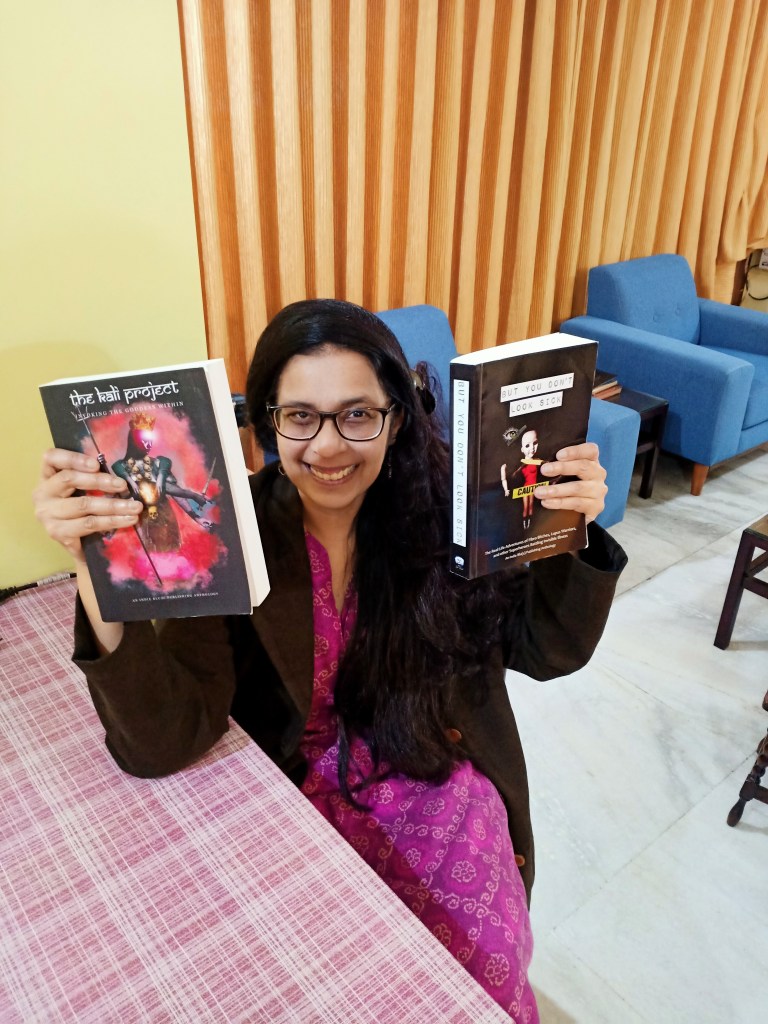
Vandana Kumar holding up the two Indie Blu(e) anthologies her work appears in.

Vandana Kumar is a gifted polyglot poet, academic and passionate writer and educator. Indie Blu(e)’s Candice Daquin and Kumar wrote to each other in French when they met through The Kali Project, mutually appreciating the love of language. Kumar is a self-effacing, gifted writer whose work is intense and informed by her travails and extensive knowledge of language and life. It’s impossible not to appreciate the widely-traveled, social-awareness in her perceptive poetry and prose. Kumar is a natural writer, but one whose love of writing has been honed by her journey with words and learning.

Kumar tells us: “(Today) It’s a sunless day in the cold capital of India. Somewhere I hear strains of ‘The Moody Blues’ number ‘Nights In White Satin’… I start to hum along “Letters I’ve written never meaning to send”… I realize my poetry journey could well have started with “Poems I’ve written never meaning to send.”

“I would write poetry and forward it to friends and they would ask me to send it to some international websites or make submissions to competitive anthologies etc., but I wouldn’t. Until a friend took matters into own her hands by submitting my work without my knowledge, to ‘The All India Poetry Competition in 2017’ which was organized by the ‘All India Poetry Society of India’ and I found to my delight, that I was included in it.”
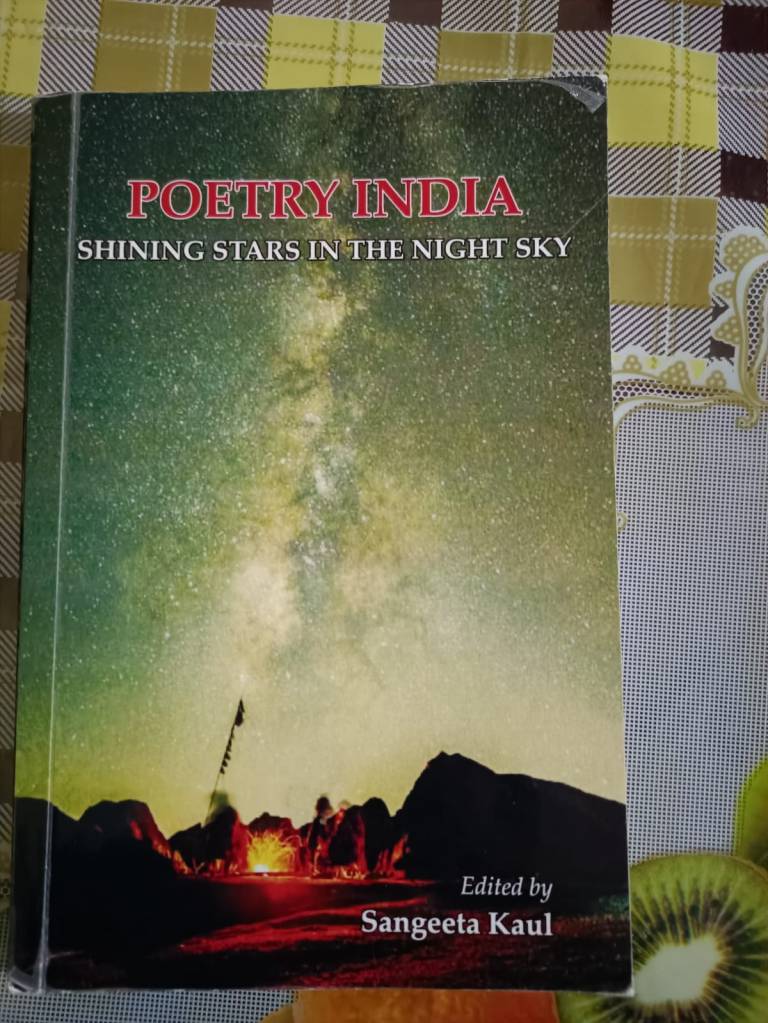
Vandana’s work appears in this excellent Indian poetry collection edited by Sangeeta Kaul.

“This started my journey of being published in other anthologies and national and international websites. It has been a rewarding journey these past few years to be accepted and published in print and online magazines, journals and websites ranging from Singapore to US and Canada and off course, India.” During this time Indie Blu(e) became aware of Kumar for her notable submissions to our anthologies: The Kali Project and But You Don’t Look Sick.

“Meanwhile, my other interests moved in parallel. I had inherited a love for the cinema from my father and missed him acutely as I became a co-producer of a crowd funded film; ‘Ek Betuke Aadmi Ki Afrah Raatein’. The film was adapted from completely different stories by Dostoevsky and Prem Chand. The film’s director, Sharad Raj’s Souvenir de mes nuits blanches premiered at the ‘Festival des Cinémas Indiens de Toulouse’ (Toulouse Indian Film Festival). Sharad Raj, runs a cinema website and I have started writing articles for this website on the subject of cinema.”

The poetry of cinema is what fascinates me. Some of my poem titles are inspired by films and I wrote a little poem in an article on Abbas Kiarostami’s film ‘Where Is the friend’s home?’ Abbas Kiarostami is a legendary film director as well as a poet from Iran.” Kumar brings up the long-established linkage between cinema and poetry, with many films throughout the 1900’s and onward, being deeply influenced by poetry; tying the two art forms together indelibly.
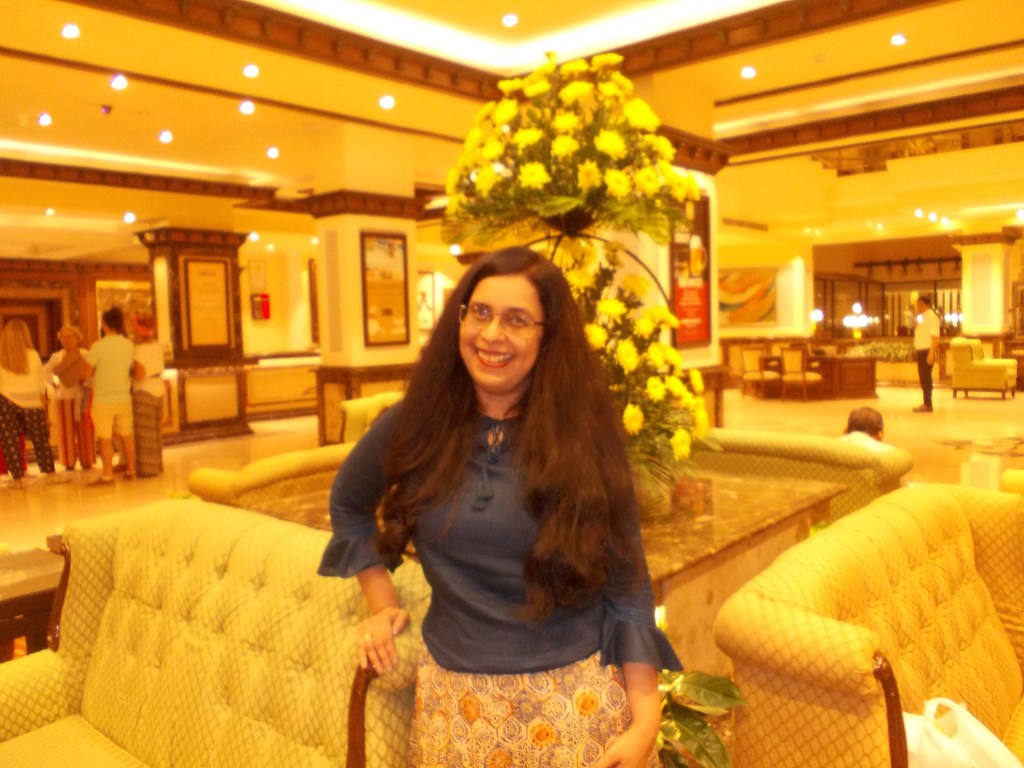
Poet, Translator, Polyglot, Teacher & Creative Force. Vandana Kumar.

“Then the Pandemic started and we were all locked up in our respective homes and like so many of us, I turned more than ever to Poetry. My poetry found a home in these pandemic years in places like the 200 year old ‘Madras Courier’, Singapore’s ‘Borderless Journal’, ‘Lothlorien’, ‘Fasihi’, UK based ‘Destiny poets’ got me a couple of special mentions and Poet of the Month in March 2021, ‘The Grey Sparrow Journal’, ‘Piker Press’, ‘Dissent Voices’ to name a few.”

Kumar was also included in a world literature series initiative where she was interviewed among many global poets. The theme of the book was critical thought in the 21st Century. She also secured an advance booking for being published in ‘Stray Dog’ in 2020. Her poem will appear in their journal this summer.
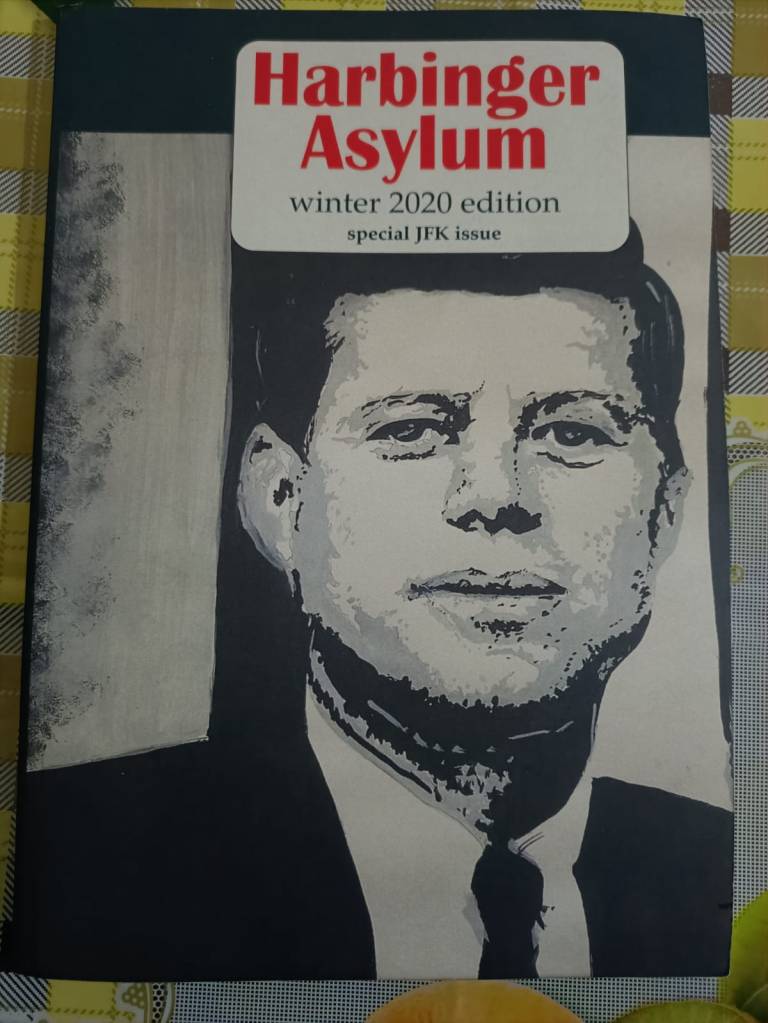
Vandana’s work is featured in this issue of Harbinger Asylum. (Winter 2020). Editor Dustin Pickering is a talented poet and writer as well as leader in the poetry community at large. He is a champion of fledgling poets and very supportive of international poetry.

One of the most gratifying things recently for Kumar was being editor of the print anthology called “Meet the poets of today – contemporary voices”. This was in Kumar’s words; “truly my pandemic baby.” She worked on this with Sharad Raj, a dear friend of hers and the director of the film she helped crowd fund. Cocoa Butter, the literary division of his film company wanted to tap hidden talent in remote corners of India. A lot of people participated in the competition from far flung places where they often do not have time to access anything beyond a WhatsApp.

The advantage of this – a pure submission process where submissions were far away from some of the more nepotistic or mutual admiration societies that exist on main-stream social media. During this time of working on this project, the pandemic made things topsy-turvy at times with the unpredictable always omnipresent, and the selection process was delayed. The judges were in three different parts of the World coping with the impact of the numbing second wave and lockdowns.  Against all the odds, the book was launched in November 2021.

Kumar says: “Finally – last but never least, I must mention my very special relationship with Indie Blu(e) Publishing. I was thrilled to find two of my poems in their epic Indian feminist anthology, The Kali Project: Invoking The Goddess Within –. It was a finalist in the prestigious National Indie Excellence Awards 2021’. I noticed recently The Kali Project anthology is part of the ‘North Carolina Regional Library and I’m so proud to have been included in this respected body of work.”
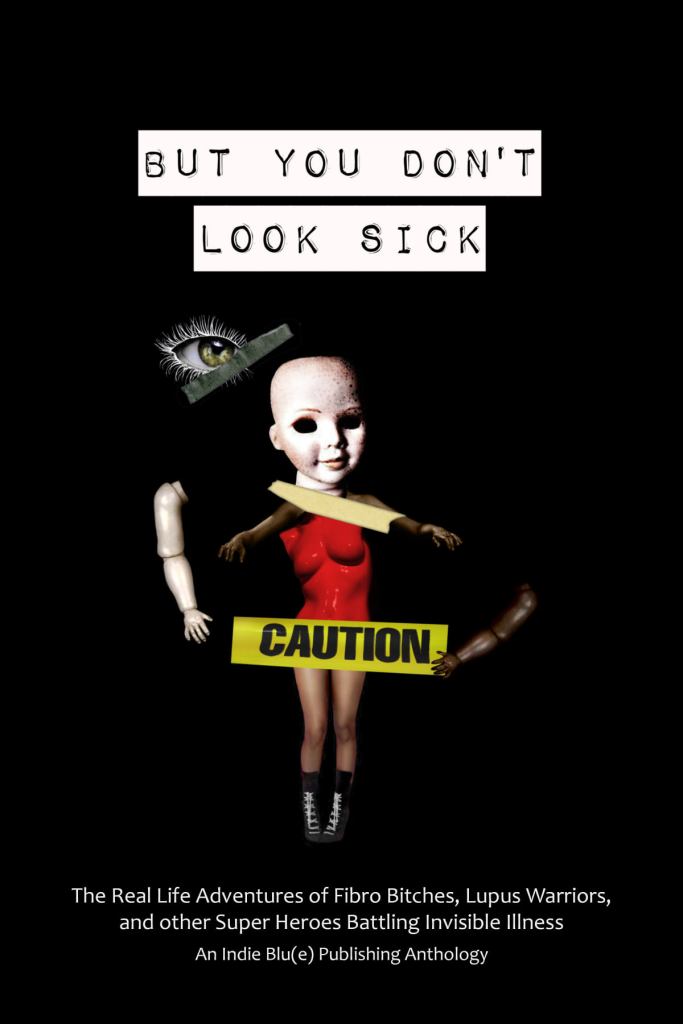
Kumar’s work was featured in Indie Blu(e)’s anthology in invisible physical illness.

“In November 2021, a poem of mine featured again in Indie Blu(e)’s anthology But You Don’t Look Sick. This anthology looked at invisible physical illness and the struggles many go through when nobody may see that struggle from the outside. I submitted to the anthology as the theme fascinated me.

“Being chronically asthmatic and having bouts of severe lung infections throughout my life I could relate to it. My prosthetic eye frequently gets infected and leads to debilitating headaches and watering. These are things – things that don’t usually qualify as being ill but they can stop you in your tracks. The anthology has been divided into categories and poems on heart, lungs and varied different ailments are there.”

“It really got me thinking about how many of us go through our daily routine, mess and chaos- hiding demons, debilitating illness of all kinds, daily chronic issues that people dismiss as ‘Oh! Plain Drama’ or ‘she is always sick”.

“(I found that) Indie Blu(e) builds a warm relationship with each of their contributing poets. The way they accept your poems to their announcements of launch and publicity. It’s like a family that gives home to your poetry in a very special way. I’m really proud to be part of this and I aim to continue writing and publishing my work as I have been, undeterred and glad to be part of the poetry community at large.”

Indie Blu(e) first published Kumar’s work in the award-winning The KALI PROJECT.

Kumar’s work can be found at MAD SWIRL HERE

SPILLWORDS HERE

also MADRAS COURIER HERE

also DISSIDENT VOICE (the black history of music) HERE

Midnight Craving: A poem of Vandana Kumar’s featured in the anthology SHINING STARS IN THE NIGHT SKY.

Vandana Kumar is a bon vivant who loves travelling, working with young minds and exploring possibilities beyond the ordinary. She is a middle School French teacher in New Delhi. Her passions include playing the piano and quizzing. Further she is a French translator for various reputed companies and publishers. An educator with over 20 years of experience, she is also a recruitment consultant.

Her poems have been published in international journals like ‘Mad Swirl’, ‘Lothlorien Poetry Journal’, ‘The Quiver Review’, Toronto based ‘Scarlet Leaf Review’, Philadelphia based ‘North of Oxford’, Saint Paul, Minnesota based ‘Grey Sparrow Journal’, California based ‘The Piker Press’, Canada based ‘Halcyon Days’, Santa Rosa, California based ‘Dissident Voice’, Founder’s favourites, W-Poesis etc.
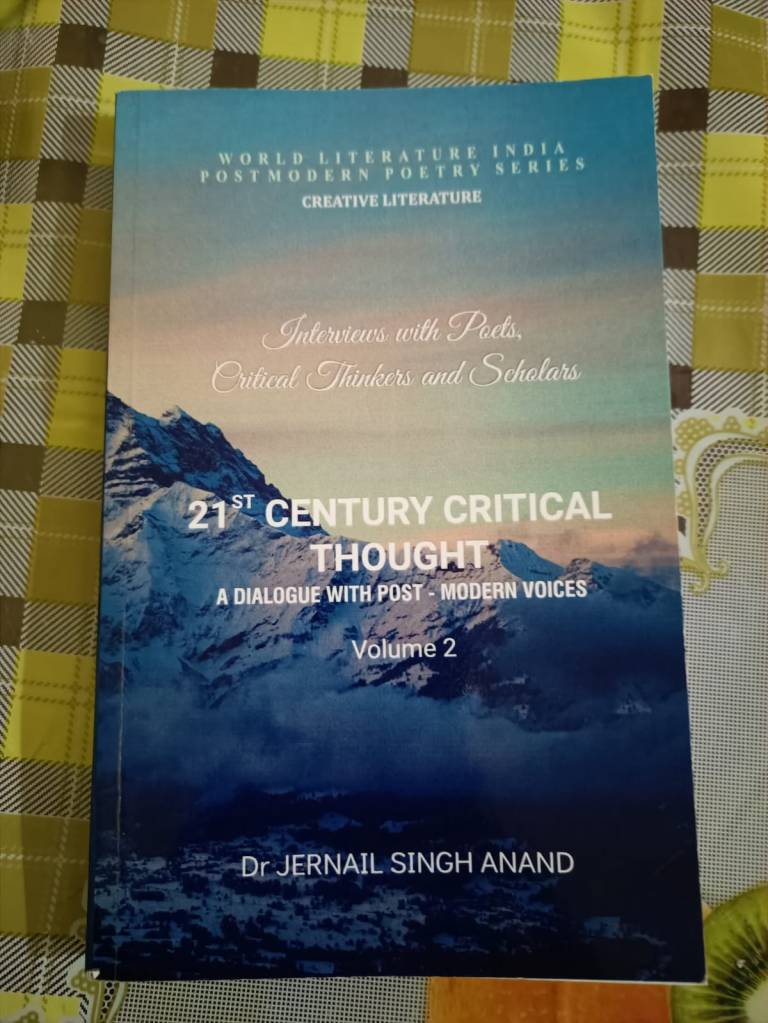
Kumar’s work is featured in this collection – World Literature India Post Modern Poetry Series Vol 2. Edited by Dr. Jernail Singh Anand.

She has also been published in the prestigious ‘Madras Courier’. She translated one of Dr. Ampat Koshy’s English Poems into French which appeared in the ‘Fasihi magazine’. Five of her own poems have also featured in the ‘Fasihi magazine’. She has featured in the book ‘POSTMODERN VOICES – Volume 4’, which is a part of the ‘World Literature India Series’, where she along with five other poets from around the World have been interviewed and it carries fifteen of her poems. She was a jury member for the ‘All India Poetry Competition’ organized by ‘Cocoa-Butter’ and also co-edited their debut print anthology that resulted from this competition.

Apart from poetry she also writes articles on cinema. Her articles on cinema have appeared on websites and journals like ‘Just-cinema’, ‘Daily Eye’, ‘The Free Press Journal’, ‘Boloji.com’ and ‘The Artamour’. Poetry for Vandana Kumar, is her stress buster, her flight of fancy and strangely, what keeps her rooted too.

Indie Blu(e) Publishing is VERY proud of our authors / poets / artists and contributors to our anthologies. We love highlighting their accomplishments. If YOU are a IB contributor and wish to have a profile here, please get in touch (indleblusubmissions@gmail.com) including information we’d like to promote on our website such as: Bio, photo, live readings, links, interesting information and one short exert or poem. http://www.indieblu.net HERE.

Vandana Kumar – @ Destiny Poets HERE.


What’s the difference between vanity presses, small presses and other kinds of publishing?

When you’ve written a good book, be it prose or poetry, the next step is to find a publisher. If you are a relative unknown, you may be doing this without an Agent. If so, it can be hard to know what kind of publisher to choose.

Vanity Press

Typically a ‘vanity’ press refers to a publisher who takes some money upfront for their services. They may dress this up in a variety of packages but the bottom line is, they will ask you to pay for something. This is not to be confused with buying your own cover art.

Vanity presses do a good job of deemphasizing their ‘vanity’ aspect and focusing on the benefits. The reason for this is because for a long time publishing through a vanity press was considered ‘cheating’ by the publishing world at large and frowned upon.

This has waxed and waned as people have different needs and sometimes a vanity press can more closely meet the needs of an individual than a regular press. Example being: You want to break into a new marketplace that you are unfamiliar with, or you wish to have a large publisher behind you but without an Agent you can’t get a large publisher interested in you so you choose to pay a wing of that larger publisher who will by proxy, promote you more than a smaller publisher could.

Traditionally many famous authors employed vanity publishing as their mode to getting their first works out there. Unable to get Agents or Publishers interested in their work, by using a paid approach, they gained the attention necessary to be picked up by a non-vanity-press at a latter juncture. Read up on the company before signing ANYTHING and know exactly upfront what you are expected to spend.

Pitfalls: People may think your work is less legitimate because they are aware you paid to get it published. Other publishers may think the same. You might have to pay quite a bit. You have no guarantee of success.

Benefits: Many vanity publishers have a lot of comprehensive packages that focus on getting your book out there, so the marketing and design elements are heavily emphasized which can be challenging otherwise. Their potential reach could get you the exposure you’re looking for.

Self-Publishing:

Typically vanity presses and self-publishing are related. The negative thought is they are ‘vain’ because you’re not actually under contract with a publisher willing to take a chance on you without any exchange of money. When you self-publish you often have to pay for: Editing services, ISBN, any other listings, upload costs to distributors and platforms, formatting services, and cover design. You shell out as much sometimes as you would going through a vanity press. Increasingly you also have to know a lot about technology to navigate the systems to upload your book successfully.

Pitfalls: When you self-publish you don’t have a legit publisher behind you so your work isn’t listed as published by a legit company.

Benefits: You have total control over your product and learn a lot along the way. You can connect with other self-published folks who will give you tons of advice.

Small Publishers / Micro Publishers:

Small publishers accept your work without any money exchanged. If you decide to pay for a cover designer you may pay for this outside your contract and the company, but within the company all the editing, promotion, and putting together of the book is paid for by the publisher, who essentially believes in your work enough to pay those expenses.

Small publishers vary. Some may be more ‘take em in, spit em out’ approach, where they publish a lot of authors throughout the year and earn by the sheer quantity of authors published. In those cases, you may not get the ’boutique’ experience and be expected to be pretty self-aware of the process. Other companies may be more hand-holding and go through every aspect of the publishing experience closely with you.

Some small publishers are more invested in that process and will assign you a dedicated editor you work closely with, versus expecting you to submit a finished manuscript and suggest few edits. For newbie writers, our recommendation is always seek a publisher who can meet your needs. If you know you need a lot of edits (and 99 percent of us benefit from close editing) select a publisher you know will work closely with you.

Occasionally a small publisher will expect you to buy pre-sale copies or a certain amount of books to ‘justify’ their taking you on. This isn’t ethical and you should check with your publisher before signing a contract if you believe this is happening. Essentially that is another form of vanity publishing and not fair to the author. Yes publishers have to earn a living, but not at the expense of the author.

That said, it is your responsibility to market your work – as you are your best marketing tool. If you don’t have a social media presence, get one, because these days that’s what it takes. Do not expect a publisher to be able to sell hundreds of your books without you putting in significant work. For example: The authors who sell the most through Indie Blu(e) work their butts off to promote and sell their work – it benefits them and creates exposure for future projects and gets others interested in them, it’s how they get ahead.

Pitfalls: A small publisher cannot compete placement-wise with a huge publisher, they’re not going to be able to get your books into the front row of your local Barnes & Noble. Only huge names from huge publishers achieve this – although it’s worth going in yourself and talking about being featured in the ‘local’ authors section as this is popular.

Benefits: You get a close working relationship without having to shell out money. You get to have a lot of help in producing your book. The costs of publication are covered by the publisher. You are part of the indie-author world and networking can be a blast.

Large Publishers:

Large publishers will not accept unsolicited manuscripts. They nearly all expect you to have an Agent. We are often asked how do you get an Agent if it’s so hard? It’s sadly a little nepotistic, all about who you know. We recommend you network like crazy with literary journals and editors and people in the business, in the hope of finding someone who can recommend you. The more you put your work out there, the more it will garner interest.

Large publishers will have a dedicated TEAM assigned to your book. You will have marketing campaigns that extend to placement in all bookstores and signings and readings will be organized for you. You will not have to pay out for any of this – but you will be expected to be the kind of talent a large publisher can promote easily, so that means working hard alongside them and pretty much doing what you are expected to do to justify the investment made in you.

Pitfalls: You might be under some pressure, so this is where you have to be pretty confident and get over any stage fright. You will be in the spotlight but this is how you sell. You won’t be able to cherry-pick, this will be at the behest of the company and that may include cover design and what edits are made. The percentage you earn per book will be less than you earn with a medium-sized or smaller publisher but if you sell more, you make more. Remember that not all authors who get published by a large press, actually go on to be commercially successful, although the chances of becoming definitely go up.

Benefits: It’s a large publisher! You’ve got every chance for success. Once you get there, doors open that are harder to open lower down on the ladder.

Obviously, there is much more to all of this BUT this is the skinny on how publishing works today. The important thing is to really consider how you fit with the above and what will work for you before approaching a publishing house – and this includes considering:

Am I a good fit for the company? Check out their website, the feel and ‘vibe’ of their people and previously published books. Do they seem on the same wavelength?

Will they get me where I want to go? (But be realistic about this too, sometimes the first step, however humble, is still the first step and a worthy one)

Do they have a good reputation? Big isn’t always better. Neither is small. Read how others have fared.

Good luck! Fortunately, there are many publishers out there and so the chances of finding a fit for your book are pretty high. We at Indie Blu(e) love our authors and do all we can to promote them whilst they are under our wing. We hope you find the same close relationship for your next publishing journey. Be realistic. But don’t settle for less!

http://www.indieblu.net

Authors in Indie Blu(e) Anthologies: Shweta Rao Garg

Shweta submitted to Indie Blu(e)’s, The Kali Project and we have a special passion for ARTISTS of her caliber; it was challenging because the series of Kali paintings Shewta had submitted were all outstanding – depicting Kali in ‘ordinary’ life in such a haunting, powerful way. We wanted to use them all but unfortunately we print in black and white in the interior of our anthologies (or they would be prohibitively expensive!) and some of Shweta’s gorgeous paintings weren’t done justice in black and white. Once you have seen Shweta’s artwork you don’t forget it. We really hope to work with Shweta again.

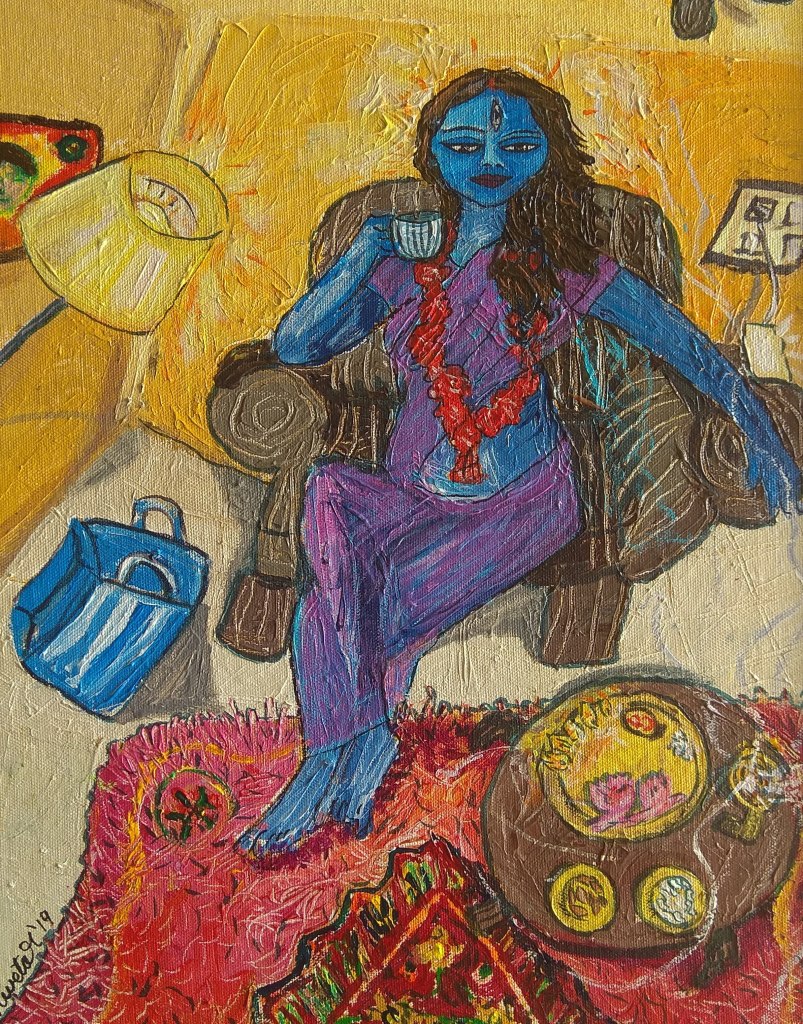
The Visitor – (in the Goddesses series and published in The Kali Project).
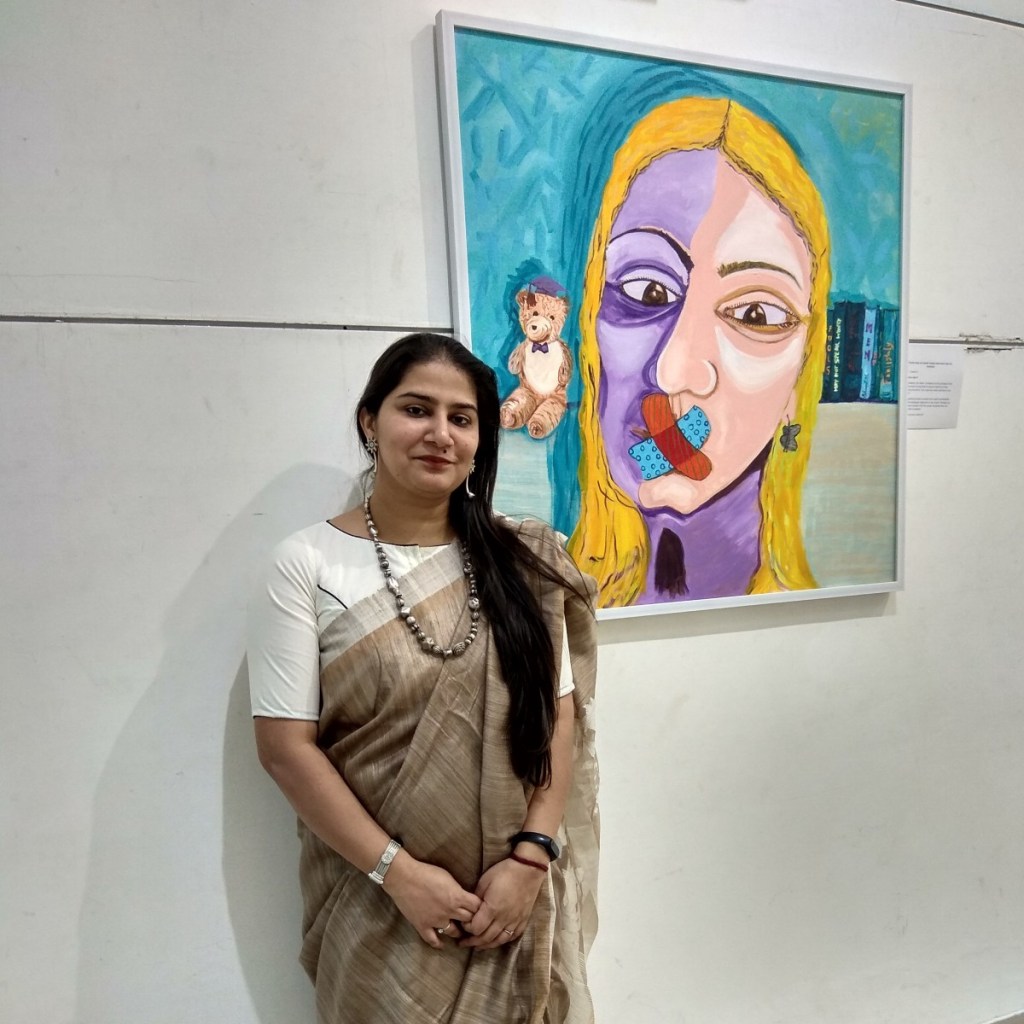
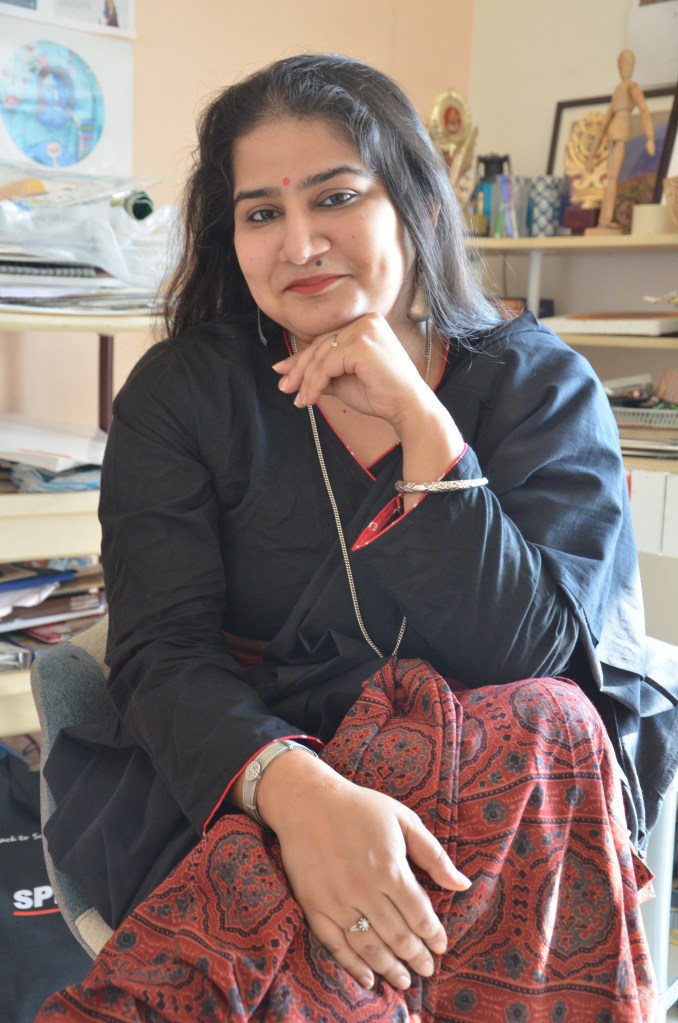
Shweta Rao Garg in front of some of her art.

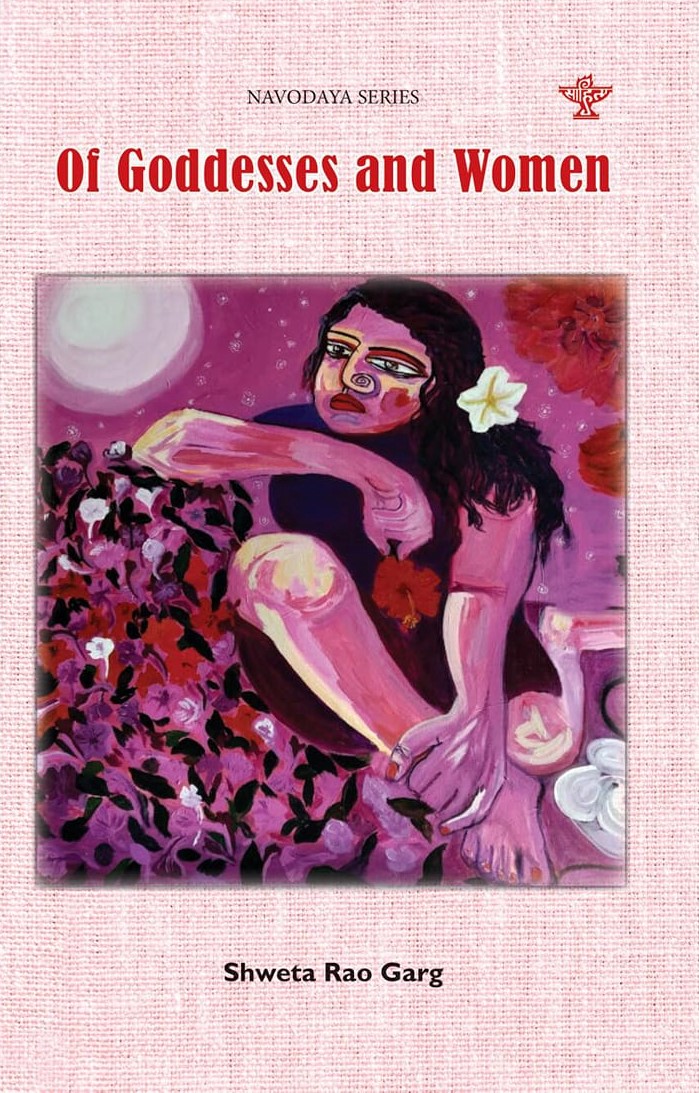
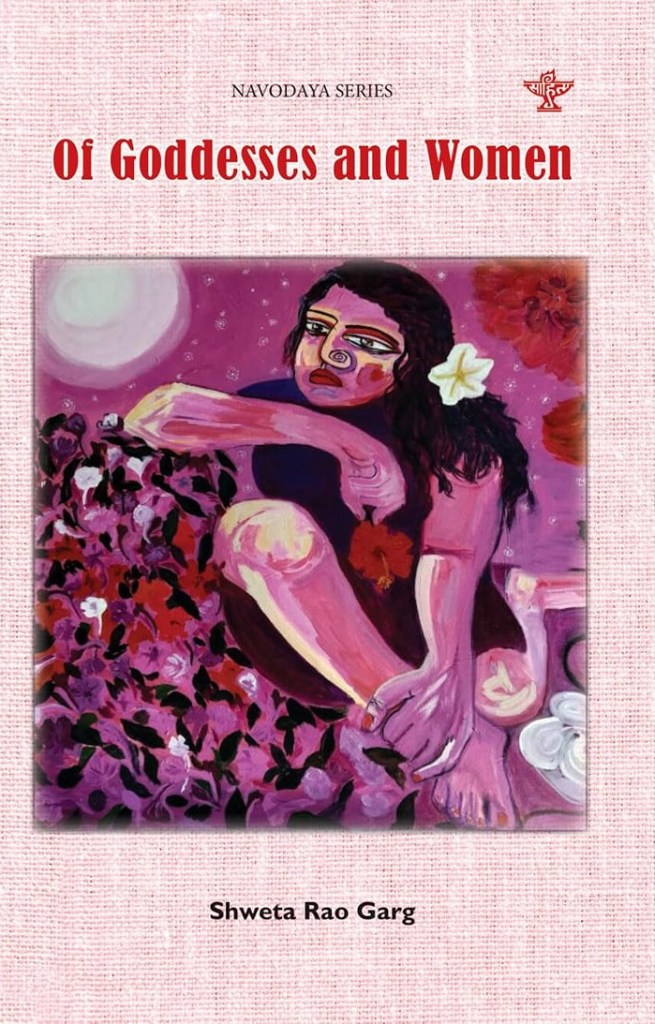
Shweta Rao Garg is an artist, poet, and academic. Her collection of poetry, Of Goddesses and Women, was published by Sahitya Akademi in 2021.
Her poems have been published in Indian Literature, Coldnoon, Everyday Poems, Postcolonial Text, Transnational Literature, Muse India etc. Her poems are about her lived experiences as a woman; mythology, popular culture, love, and motherhood are recurring themes. Her poems are intertextual and layered as they are ironic.

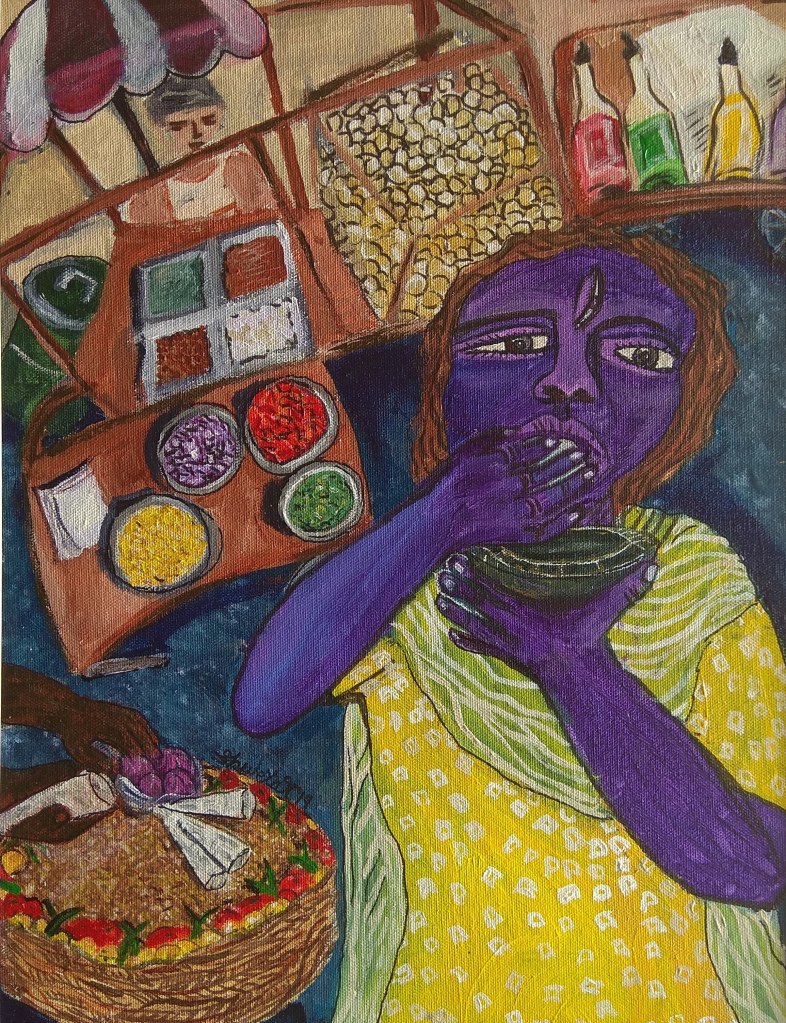
Of Goddesses and Women is Shweta’s series of artwork where goddesses and women are depicted in ordinary urban scenarios. In these paintings, Kali does ordinary things, like visiting friends for tea, or having street food like any other woman would. This is Shweta’s way of juxtaposing the divine with the mundane. Her art or her poems on the goddesses comes from the place of intimacy, nor irreverence. At many levels, it celebrates women’s bonding. 

Shweta’s artwork can be found via her website HERE  www.shwetaraogarg.com and you really should visit this site of hers, because it’s got some of her most striking pieces including the series of KALI paintings in high resolution color.

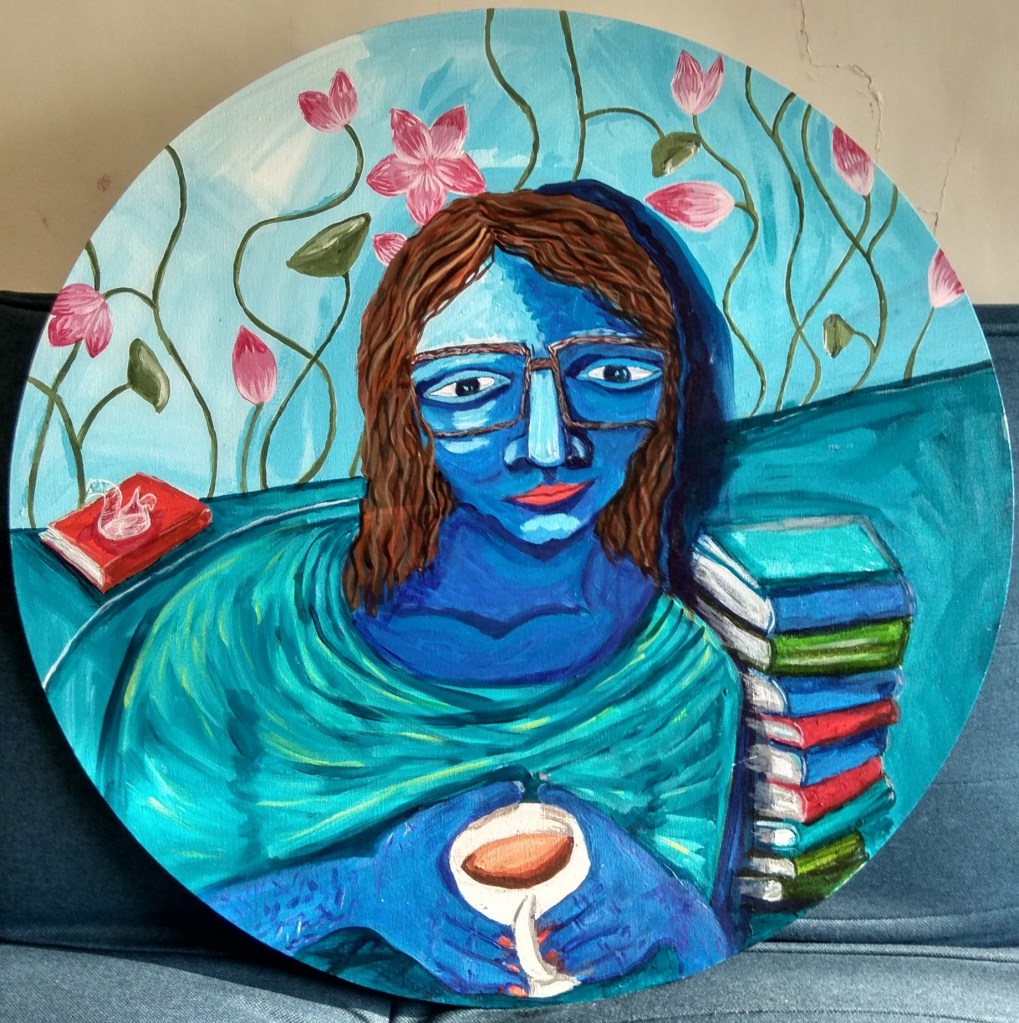
Shweta’s artwork.
The Street Food Queen – part of the Goddess Series / Shweta Rao Garg

Link to readings :
https://www.youtube.com/watch?v=RI-0hlTO-0I
https://www.youtube.com/watch?v=3pFm98-FQK8

Website :
https://shwetaraogarg.com/

Instagram :
https://www.instagram.com/shwetaraogarg/

A section of: POETRY RISES
(For Smeetha Bhoumik)

From the ravages of Kurukshetra
It smears gold across the wheat fields
From the dungeons of tyrants
It reverberates in every street
From the shackles of the shiploads of slaves
It clanks in the beats of blues
From the gas chamber of fascists
It flies into the parliaments of hope
From the ruins of Palestine
To the lullabies of safe homes
From the crematoria puffing human lives
To the healing corridors of hospitals
Every time a heart beats its last
Poetry lives in memory

(Published in full in MUSE INDIA https://museindia.com/Home/ViewContentData?arttype=feature&issid=97&menuid=9467)

The artist and poet herself.

Exert from Candice Louisa Daquin’s review of Of Goddesses and Women by Shweta Rao Garg, Published by Sahitya Akademi, 2021. ISBN : 978-93-91494-63-6 – The Divine and the Ordinary in Shweta Rao Garg’s Poetry:

The gift of reading Indian poetry in a language I am fluent in, is how much I as the reader learn from such writing. Like many outsiders, I find India and her history, absolutely fascinating, and that includes her Goddesses and the modern Indian woman. Shweta Rao Garg has brought these Goddesses to life once more in this beautiful collection. As the writer of her foreword notes: Shweta Rao Garg found in Hindu mythology, facts to ponder and dwell upon.” (x) For the outsider, who appreciates the richness and depth of Indian history and mythology, this is to be cherished.

Personally, I am a great fan of longer poetry, which many writers apologize for, when they send me books. I think there is a lot to be found in a longer poem, which is not to preclude the value of any length, as surely, it’s not the marker of a good poem. In a longer poem however, you can find an entire story and this especially lends itself well to stories of mythology, faith and Goddesses. It was one reason I liked Shweta Rao Garg’s writing for The Kali Project and I found myself enjoying what I could learn and savor from Shweta’s observations and detailing of the Goddesses.

Another aspect of poetry I am particularly drawn to, that Shweta excels in, is ending a poem softly and with gentle but piercing observation. If you imagine reading a poem out loud and then at the end of a journey through the eyes of the poet and subject, you are given something very small to focus on, it is an unintended poetic technique that balances the grandeur of the storytelling with something seemingly unimportant, that actually evokes the entire theme.

A classic example of this can be found in the first poem, “At the Hidimba Temple”:

I turned around to take a last look

At the shrine surrounded by pines,

Unassuming, aloof,

Blocking the sun.

I comfort myself to see my own footprints

Stubby, small blot on the velvety snow. (2)

The delicacy of writing where you are able to almost ‘conduct’ poetry as you would music, and make it swell and rise, and then fall softly, is quite an art and not something all can do. Shweta’s ability to convey an understanding of history and myth alongside her way with language, is exceptional and memorable.

Of Goddesses and Women is hard to define as it is far more than one genre but its all encompassing theme is that of appreciation for women in all their incantations. I find this especially valuable, given how many women’s voices have been historically muted. Shweta is the kind of modern Indian woman you hope to read, for her unfiltered recounting of the dilemma of being a woman in a world of objectification and historic oppression: “May you give me a few lines that I / May speak with another woman / May we not speak about the man / Who moves your story forward.” (“Filmy Prayers”, 62) There is an ocean of hope in these revelations as well as a sorrow in divining their truth. When paired with reflections on Indian’s Goddesses, I see a merging of the mythology of women with the reality of women that reinforces the feminine and empowers women throughout the world. We have all some part of this journey, and Shweta has a way to gift that universal message through her gentle battle cry;

I don’t resent my breast

Nor do I wish to shed them

My womb enshrines not your lust

But my poems

I stay immune to your gaze

Defiant, impenetrable,” (“Akka”, 8)

Another accomplishment that stood out for me was Shweta’s ability with English. I don’t say this patronizingly but as one who learned English as a second-language also. It is not easy to get the nuance right and even with some of the best Indian poets, there are many times a line or two won’t sound quite the way it would be said by a native speaker. That’s not always a bad thing, it can in fact be a delightful variation that imbues an Indian essence into the language. I found with Of Goddesses and Women Shweta was able to imbue her Indian essence whilst mastering the language flawlessly.

She is essentially a wordsmith with that adroit nimbleness of a true writer, able to flow words in ways someone plays the piano or harp or violin. I find reading her poetry in my head, I am moving in time to the cadence of her wordplay and it impresses me time and time again how clever she is at rendering this through words. An American (since neither of us are) might say Shweta Rao Garg is damn clever and they wouldn’t be wrong:

I wish I can slip an envelope

With a stash of poems

In your aged leather purse

If you are out of cash

You can read out a verse

And complete the transaction. (“Packets of Poem”, 74).

There is such a cleverness but it’s a really romantic kind of cleverness, not a self-satisfied kind, so you feel an openness and warmth with her wordplay. This is exactly what stood out to me when I first read Shweta’s work and I’m so glad she’s put this gift to good use in this homage to Goddesses and women, what better subject! I do not feel qualified to comment on the more cerebral aspects of the book in relation to mythology but my knowledge of and appreciation for India, its incredible women and Goddesses, was dramatically increased.

I read a lot of American poetry as part of my job but it is a true delight to read modern Indian poets, especially female. As a life-long feminist I am invigorated by the insightfulness, talent and depth of Indian female writers, not least their poets who transport me to India and help me experience both the beauty and horrors of India. I think that marriage of extremes is illustrated so well by Shweta Rao Garg who intuitively understands the layers beneath what is obvious. In many ways she has succeeded effortlessly in marrying Indian myth and history with the rest of the world, demonstrating the alacrity and vast knowledge of India’s women; “These were not the flat / Pink roses adorning Plath’s walls. / My Morning Song / Was sung by thousands of marigolds.” (“Arrival”, 25). What a barren world it would be without these powerful, unapologetic voices, claiming their over-due place within the literary cannon and improving it vastly.

There are frankly some books that are a joy to review. Of Goddesses and Women is definitely one of those books. I could easily write pages on my enjoyment, appreciation and respect for Shweta Rao Garg’s work here. She pierces the obvious with such intensity it leaves me shaking my head in wonder with a little envy and a ton of respect. There is something very edible about Shweta’s choice of words, and the alacrity of her deeper understanding of what makes us tick. It is both funny, prescient and slightly horrifying, which I think is the truest language of a poet worth reading:

i am about eating

cola and corn

in the dark multiplexes of freudian complexes

i am about clumsy, lumpy, fleshy labyrinth

about skin patterned with moles, freckles

about broken tooth, decays, flying dentures

about vision flawed and ensuing adventures. (“The Body Ordinary”, 49)

*The Kali Project: Invoking the Goddess Within Ed. Candice Louisa Daquin and Megha Sood. Indie Blu(e) Publishing, 2021.

Link to recent online poems:
https://museindia.com/Home/ViewContentData?arttype=feature&issid=97&menuid=9467
https://yugenquest.com/shweta-rao-garg-we-icwp-prize-20-we-glowing-aesthete-prize-20/
https://shwetaraogarg.com/why-read-poetry/

Indie Blu(e) Publishing is VERY proud of our authors / poets / artists and contributors to our anthologies. We love highlighting their accomplishments. If YOU are a IB contributor and wish to have a profile here, please get in touch (indleblusubmissions@gmail.com) including information we’d like to promote on our website such as: Bio, photo, live readings, links, interesting information and one short exert or poem. http://www.indieblu.net HERE.


Authors in Indie Blu(e) Anthologies: Dr. Molly Joseph

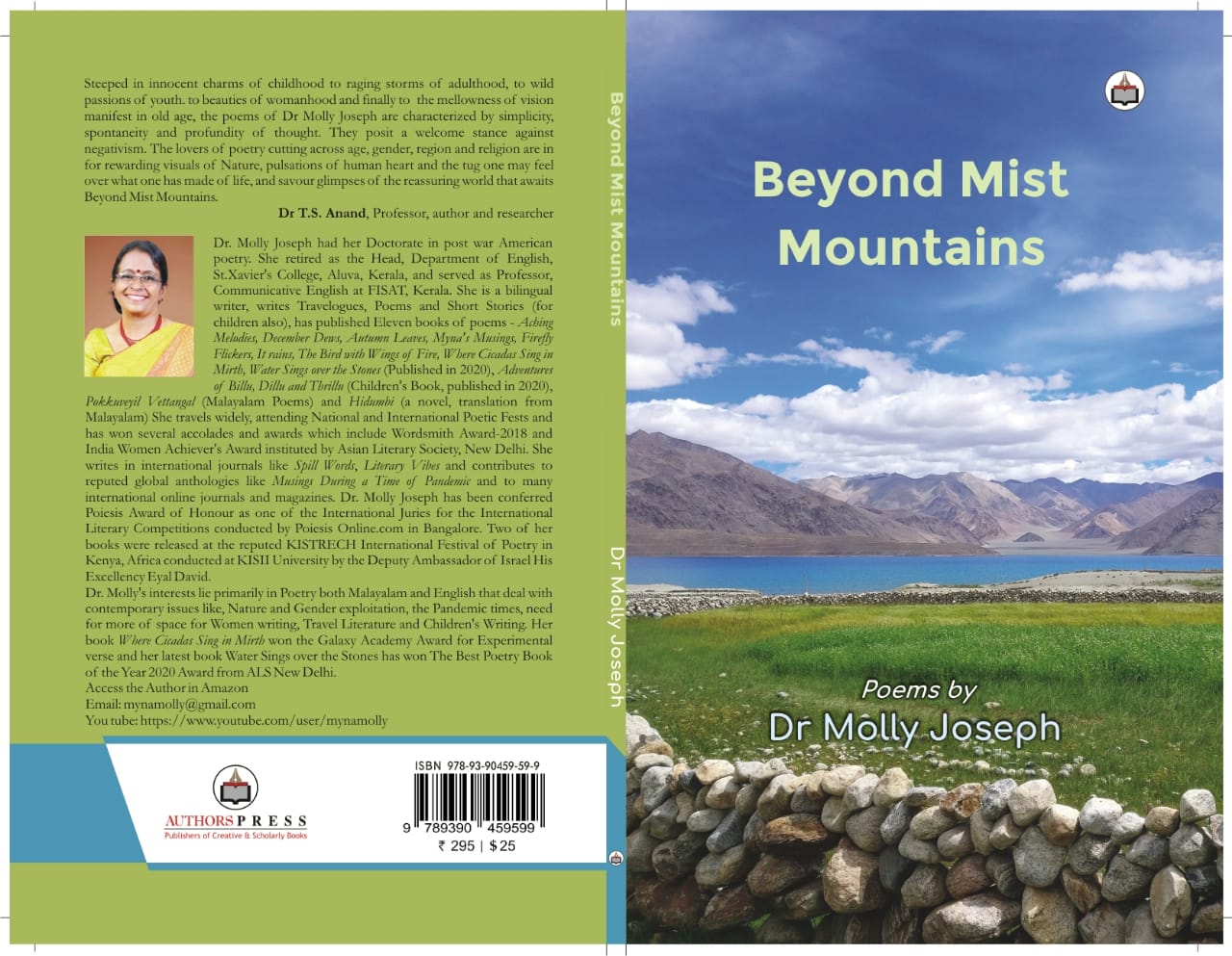
Beyond Mist Mountains, by Dr. Molly Joseph is coming out this year, 2022.

Indie Blu(e) Publishing has had the honor of publishing a great number of internationally famous, locally respected and incredibly talented authors, poets and artists. Our series of profiles on these talented writers and artists continues with the eminent Dr. Molly Joseph whom we were fortunate enough to feature in The Kali Project. Dr. Joseph is a leader in her field and a highly compassionate human-being. It was such a pleasure to include her work in The Kali Project as her poetic voice is very well-known and much respected and as an Indian female poet she forges the way for those who come afterward. We were incredibly lucky to have a talent of her caliber in Kali and we are immensely grateful for her support of that necessary and important anthology.

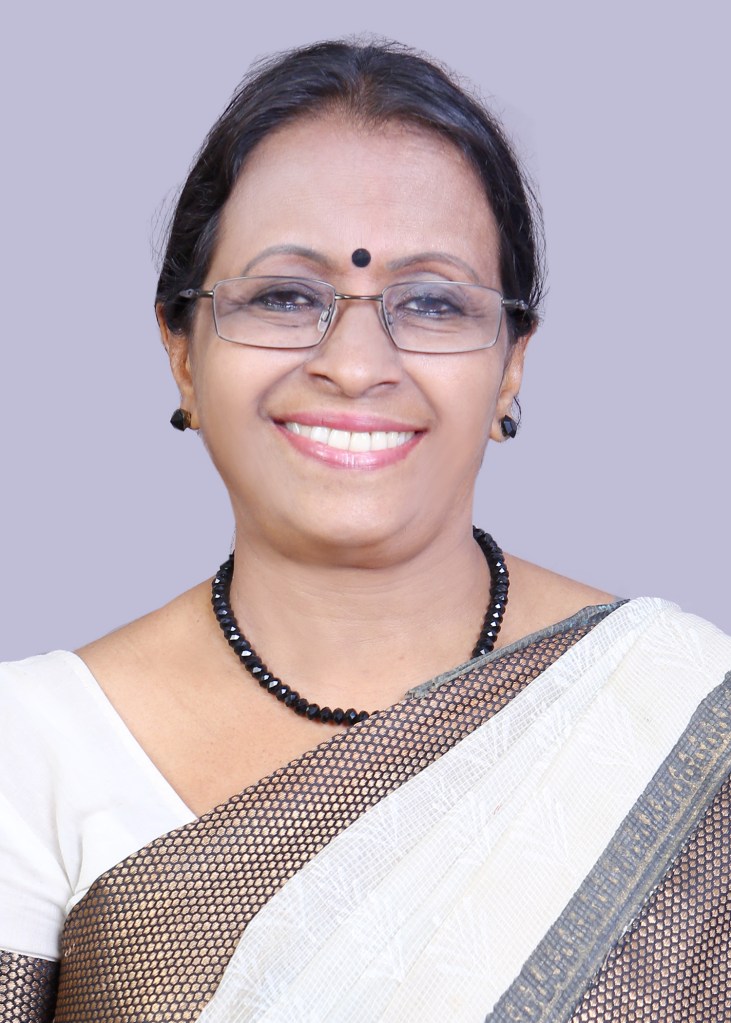
Dr. Molly Joseph is a Professor and Poet from Kerala, who in addition, writes Travelogues, Short stories and Story books for children. Incredibly prolific, she has published fourteen books thus far, 12 Books of poems, a novel and a Story book for Children.

Author Molly Joseph.

She has won several accolades which include India Women Achiever’s Award  2020. She believes in the power of the word and writes boldly on matters that deal with the contemporary. She can be reached at :
E-mail – mynamolly @gmail.com 
Youtube – https://www.youtube.com/user/mynamolly

Dr. Joseph’s 15th collection of poems Songs of Silence is with Authorspress New Delhi. It will come out this month February. Dr. Joseph is at present working on a novel, she regularly attends SAARC  Literary Meet representing India and had been to the reputed Kishtrec Festival conducted by  KISSI University, Kenya. To have a real feel of Dr. Joseph’s books you have to know the beauty and intensity of her written word and her passionate commitment to the written word. In her very soul, she’s a true poet and writer.

The Kali Project brought together some of the strongest voices in poetry from Indian poets and artists.

Molly said of working with The Kali Project:

It was a very fulfilling experience to be a part of the much meaningful Kali  Project. Woman being the creative principle of life, need this kind of highlight,  not only  to establish her  unique niche  in this world, but also to build within themselves  a self assured significance of her own  vital role in this  fast evolving scheme of things.  Such a Project turns out so seminal offering a plethora of perspectives for  woman hood.”

                                         Poet

                                    life touches

                                     You script

                                        it out..

                                        slowly,

                                        subtly

                                      growing

                                          into

                                      every one

                                      every thing..

Published Books – Dr. Molly Joseph:

Dr. Molly Joseph holds a Doctorate in post war American poetry. She retired as the Head, Department of English, St. Xavier’s College, Aluva, Kerala, and  also served as Professor, Communicative English  at FISAT, Kerala. She is an accomplished bilingual writer.

Aching Melodies (2013) Poems – English Partridge – Penguin
Autumn Leaves (2016) Poems – English Authors Press New Delhi
Myna’s Musings (2017) Poems – English Authors Press New Delhi
December  Dews (2017) Poems – English Authors Press New Delhi
Firefly Flickers (2018) Poems – English Xpress Publications, Palakkad (Kerala)

Hidumbi (2018) Novel – translation from Malayalam, Xpress Publications Palakkad (Kerala)
It Rains (2019) Poems – English Authors Press New Delhi
The Bird with Wings of Fire (2019) Poems – English Authors Press New Delhi
Where Cicadas Sing in Mirth (2019) Poems – English Authors Press New Delhi
Water Sings over the Stones(2020) Poems – English Authors Press New Delhi
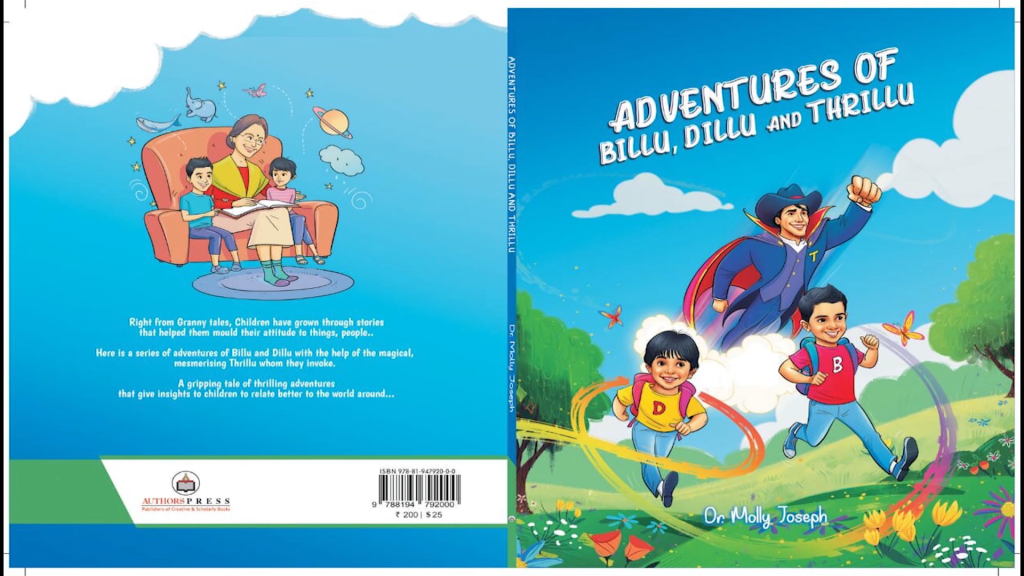
Adventures of Billu, Dillu and Thrillu (2020) – Children’s Story Book Authors Press New Delhi

Pokkuveyil Vettangal (2019) Poems – Malayalam Aksharasthree
Kottayam (Kerala)
Kurukiyunarunna  Mainakal (2021) Poems – Malayalam Authors Press, New Delhi
Beyond Mist Mountains (2021) Poems – English Authors Press New Delhi
Songs of Silence (2022) Poems – English (to be published in Feb 2022 Authors Press New Delhi

Dr. Molly Joseph was born in 1956 as the daughter of teacher parents, the late M.M. Joseph and the late Annamma Joseph at Kongorpilly, Kerala. She grew up among three brothers, got married to Mr. Xavier Gregory, and has a beautiful family, son Greg Xavier and daughter Sneha Xavier as well as grandchildren. She received her M.A. in English Language and Literature, took an M.Phil, and completed her Doctorate in Post War American Poetry with a specialization PGDTE from IFLU Hyderabad. 

Molly Joseph’s children’s book Adventures of Billu, Dillu and Thrilu.

Indie Blu(e) Publishing is VERY proud of our authors / poets / artists and contributors to our anthologies. We love highlighting their accomplishments. If YOU are a IB contributor and wish to have a profile here, please get in touch (indleblusubmissions@gmail.com) including information we’d like to promote on our website such as: Bio, photo, live readings, links, interesting information and one short exert or poem. http://www.indieblu.netHERE.

Bias in the writing and publishing world

For millennia, bias, bigotry, racism, and prejudice have been notable bed-fellows in most professions, not least the publishing world.

Most of us know women were not permitted to be authors and had to write under a male pen name if they wished to be published or taken seriously. This wasn’t so long ago.

Even more recently: The notable authoress Patricia Highsmith had to use a pen name when she published The Price of Salt (later known as Carol) which depicted same-sex love. It was felt that her reputation as an author (of The Talented Mr Ripley series, among others) would be tarnished and ruined if she were connected to a book about what was considered depravity.

Years later Highsmith went public as the author of Carol but this speaks to the epochs in time where authors are silenced or shamed for the subjects they write about or just because they are dark-skinned, black-skinned, ‘foreign’ or ‘immigrant’ and this is not acceptable to the masses.

If you don’t know this happened and is still happening then the question would be: Where have you been?

Assuming you are aware of this, let’s consider the publishing world now.

Some authors complain that only certain ‘types’ of authors are published. This can be true although it’s never a stead-fast rule. Like anything else, there are ‘trends’ and these trends dictate what the publishing world or creative world at large, are looking for. Using the word ‘trend’ implies a lesser worth and this is not the case at all. Creativity has always employed trends as certain things go in and out of fashion, all have worth (well maybe not Teenage Mutant Ninja Turtles and mullet hair cuts, but that’s debatable …)

Is it fair if you are trying to promote yourself as an author say, during a trend or shift in thinking/social consciousness, that would rather publish a young woman of color than a white 60-year-old man?

It’s fair because it is taking into account the decades, sometimes centuries, of oppression or erasure or invisibility of certain groups who did not get published or given equal chances.

If you are a white 60-year-old man, who may never have been racist in any way your entire life, or benefited from white ancestry at all, it may seem very unfair. Perhaps it is but it’s also fair. It’s one of those dualities. As much as it may be unfair to the person who is not given the chance, it is fair to the person who is given the chance (who would not have been previously and whose ancestors were not).

When we’re being fair, it’s never simple and it’s never completely fair. Someone tends to suffer when wrongs are righted, but the idea is those wrongs were worse than any negatives that come with righting them. Change isn’t painless.

If you perceive you are someone who isn’t the dish of the day in the publishing world, then you might well be right. The publishing world like the art world and creative world at large, is nepotistic, slightly pretentious, and definitely particular to certain shifts. Sexism, racism, ageism, ableism, they’ve been guilty of it all at some point or another, and may still be.

Even now – the number #1 best-sellers are white males. This is not because white males write the best books. It is because the legacy of oppression of other groups such as women and people of color, let alone LGBTQ+ or immigrants, is centuries in the making. So for every white male who is turned away because a publisher is deliberately looking to rebalance their scales and to some extent employ some affirmative action in their authors, there were thousands of rejected women, LGBTQ+, immigrants, and people of color turned away throughout history.

No, it’s not fair if you are a white older male and you wrote a superb book and you get turned down whilst your female black friend is published by the first place she approaches. But it is fair – if viewed in a balanced way by taking into account the oppressive history of the past. It also doesn’t mean you won’t be published if you are a white older male, chances are you will, it might not be as easy as it once was, but all doors are not closed.

We are often asked if we consider this in our decisions to publish authors. The answer is yes we do but we must continue to do better. By that, it’s not an apology because sometimes it is not easy to locate disenfranchised groups, but it should be an active-life-long process. Since our inception, Indie Blu(e) was founded on publishing those who would traditionally have been ignored by publishers either because of the material or their gender or race or country of origin or LGBTQ+ status or disability status.

Yes, we also publish folk who do not fall into any of those categories, but majoritively our authors fit at least one and often multiple categories of former (and ongoing) oppression in the larger publishing world. By being aware of this, we do not decrease quality, in fact, we believe passionately that our authors are incredibly talented and there is no tokenism or pity in our choosing their work. Even if we did a blind read, we’d choose them, because their words speak for themselves and that’s the way it should be.

However, in this world, with all its prejudices, it’s not always that way and so we are vigilant in our representation of a cross-section of diversity and talent and this includes people of every color and every continent, immigrants whether legal or not, writers with serious mental or physical disabilities, neuro-diverse writers, LGBTQ+ writers, non-binary, and many more. We’re very proud to be the house for these brilliant minds and to continually push to highlight those who might otherwise be erased. This is no longer a trend in publishing, this is the way the future should look.

If you feel you are overlooked or underappreciated by traditional publishers, consider submitting to us. HERE.