
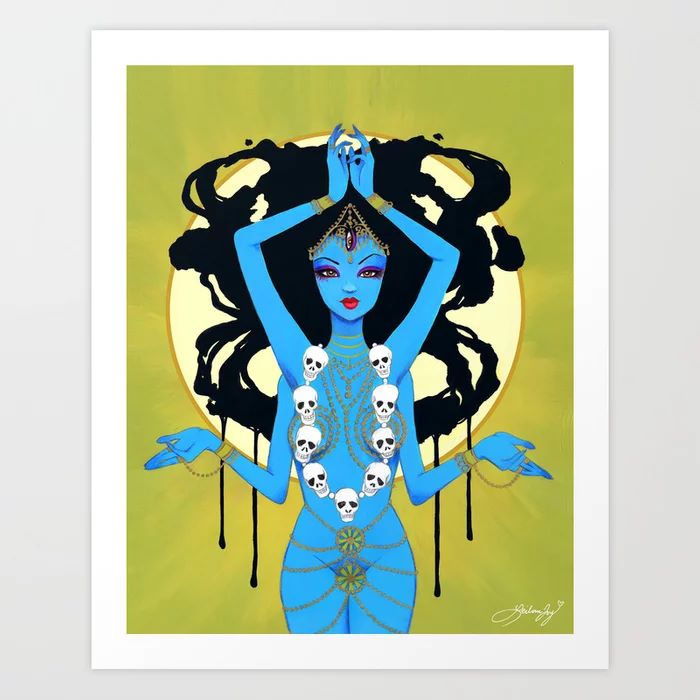
Coming Fall of 2020 from Indie Blu(e) Publishing: As the World Burns
The Kali Project was conceived by indie writers and editors Candice Louisa Daquin and Megha Sood. A dear friend starting a feminist micro press was intrigued and suggested that The Kali Project serve as their inaugural publication. Everyone involved has been deeply moved by the support and enthusiasm the project has received, as well as by the volume of submissions.
The Kali Project has become a much more involved and wonderful project than we anticipated, and it has become clear to all involved that it needs a publishing partner with more experience publishing large, worldwide anthologies.
We are pleased to announce that Indie Blu(e) Publishing has assumed the role as The Kali Project’s publisher. Candice, a founding editor at Indie Blu(e), knows their ability to manage the volume of details of such a project and to produce high quality anthologies, such as We Will Not Be Silenced, SMITTEN This Is What Love Looks Like, and the soon to be released As The World Burns.
Both Megha and Candice are grateful to tap into Indie Blu(e)’s creativity and expertise for The Kali Project. We have grown beyond our expectations and are confident that the anthology will be in good hands.
Going forward, all communication regarding the project will be coming directly from Indie Blu(e) Publishing, including contracts, which will issued upon completion of the decision-making process. We appreciate your patience and support.
We welcome our Indie Blu(e) sisters Kindra M. Austin, Rachel Finch, and Christine E. Ray to this project.
The Kali Project Team

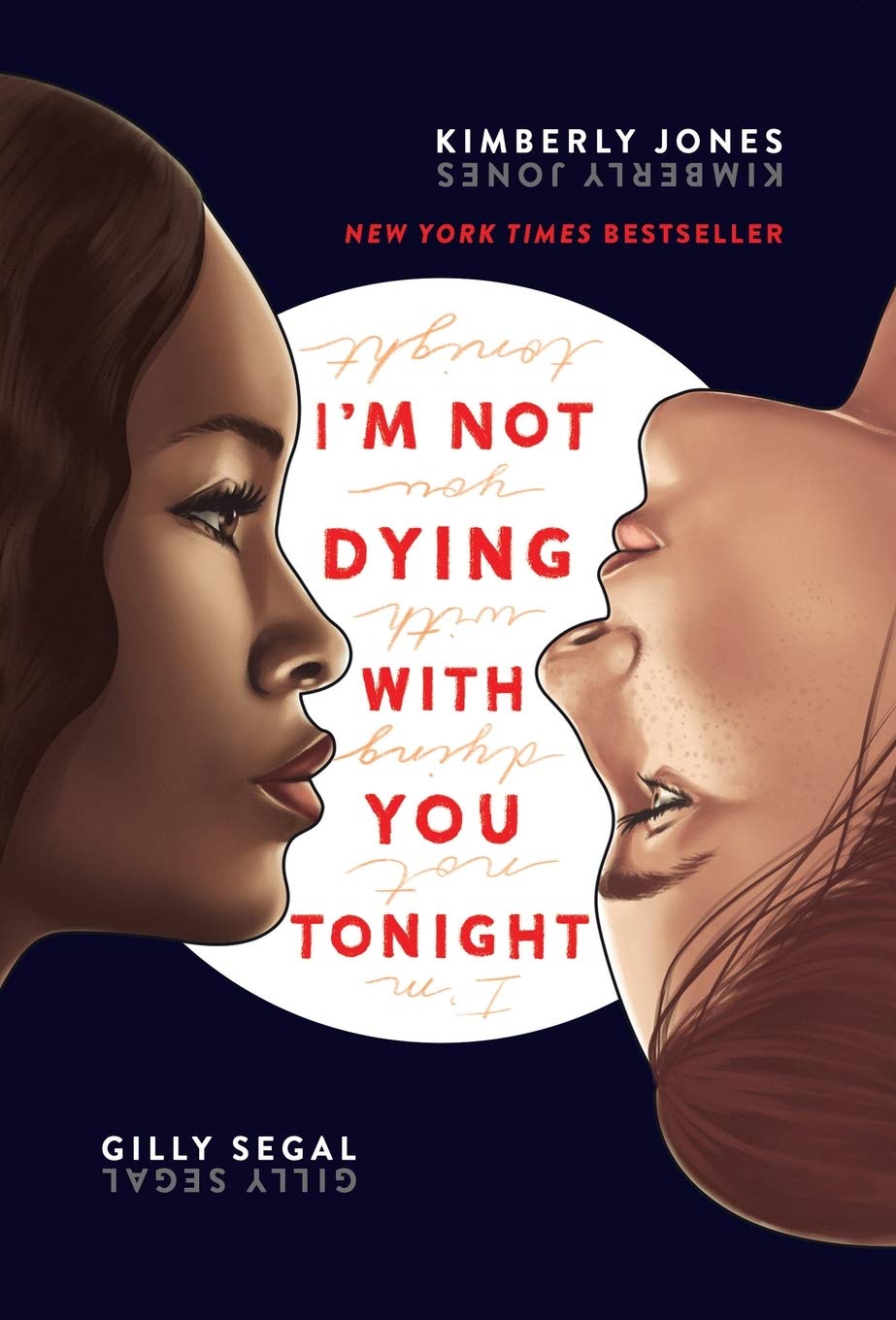
I’m Not Dying With You Tonight by Kimberly Jones and Gilly Segal is Young Adult fiction with its finger keenly on the pulse of current affairs. Told through dual narrative, Jones and Segal collaborate to tell the story of one turbulent night shared and survived by Lena and Campbell.
Forced together as a fight breaks out at their high school and gunshots are fired, Lena and Campbell must set aside their societal differences and unite in the face of civil disturbance, protests, rioting and looting. Through Lena, Campbell begins to understand the deep racial tensions within the town she has recently moved to. She witnesses Lena’s fear in the presence of the police and watches a community stand for equality and justice in response to a racist governor.
Whilst Lena teaches Campbell to acknowledge the white privilege she possesses, she learns that the new white girl in town with very few friends may be blinkered but is loyal, compassionate and prepared to fiercely protect Lena too.
Both young girls experience first hand the brutality and violence which besets peaceful protest the moment counter protestors arrive; fights and fires are unleashed and the looting begins. Both are cowed by the sight of riot police, ziptied wrists and peaceful protestors sat in silence whilst stores are ransacked. Both young girls witness the lack of justice we too have experienced this year across the globe and most especially in the United States of America.
However, I’m Not Dying With You Tonight is more than a dual narrative exploring race, privilege and prejudice. Jones and Segal interweave teenage politics, the importance of family, high-school drama, love and friendship into their narrative too. Therefore creating a YA novel which resonates deeply yet also forces every reader to question their own stance, their own privileges and prejudices and what their own actions would be if ever faced with the same scenes and dilemmas Lena and Campbell are confronted by over the course of an evening.
About Kristiana Reed:
I write about love, lust, struggle, survival, fickle things, dreams and the stars. And anything in between. You can read more of my writing at My Screaming Twenties
Her collections of poetry Flowers on the Wall and Between the Trees are available through Amazon.com and Amazon.com.uk
Hokis produced her book without anyone else, I’d say she birthed it, and as such, did not want most of us involved in its creation. It was a very personal book and it reads as such. This alone has worth as a memoir and a moment of her life put into language.
In my absence, I am substantial.
What you pine for is
pretty fucking
inconsequential.
(I AM [not a] SUBSTANCE)
Hokis isn’t everyone’s cup of tea. When I first read her, I immediately appreciated her originality but some others did not. This could be a simple case, of what is original isn’t always mainstream, but I suspect many people don’t actually ‘get’ Hokis and this could also be why she produces things without needing others.
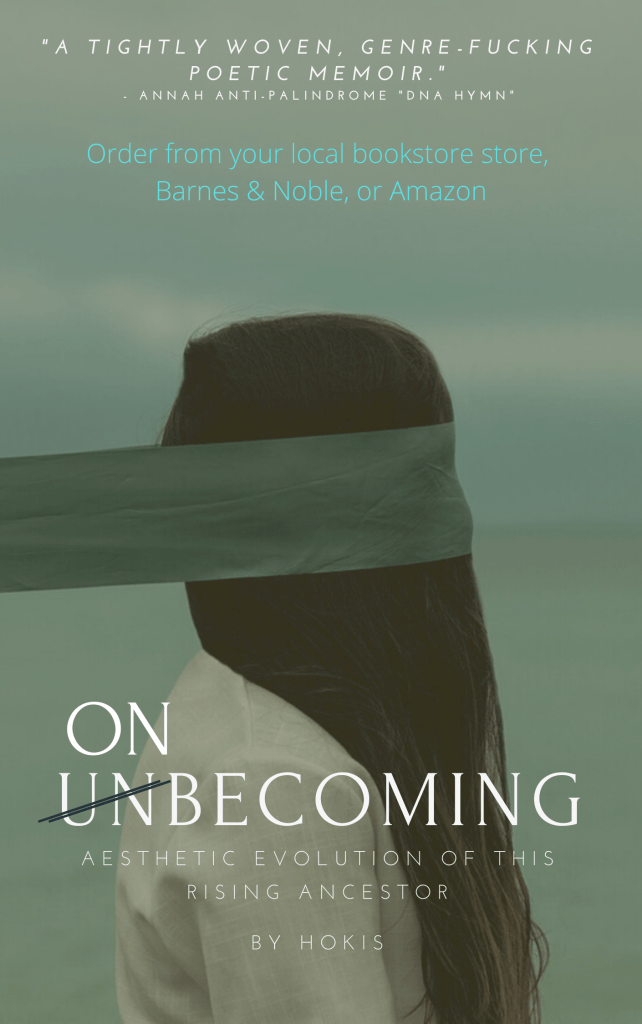
In On Un Becoming, aesthetic evolution of this rising ancestor, a poetic memoir, the first thing you’ll be drawn to is the impeccably beautiful cover and layout. This is high art with poetry. Beyond the obvious beauty, Hokis has laid down the tracks of her life thus far in an exquisitely honest rendering.
I like the feeling of dopamine’s hand
as it leads me to the apple’d tree.
I have a God complex,
believing the only person to help is me.
(BECAUSE)
People can become frustrated with certain forms of poetic license and Hokis definitely bends the norm with her continual use of structure and syntax to form a language almost of her own. A line of Hokis is not a line of poetry, it’s her sign-language. Maybe people fear those destroyed boundaries and this is actually a huge compliment;
It is all just the lonely game of words.
No matter the form, the rules, the structure.
No matter the he/she/them, it is all the same dance.
They just want to know what it feels like.
I can comply and rape myself, again.
(HERE, just take (fuck) IT)
Personally, I find this kind of poetry really intoxicatingly different, which is a positive thing, and memorable, which is what we all hope to be in some form or fashion. Not every poem blows me away, but the honesty behind Hokis and who she is as a writer, does. And when she gets it really right, she’s literally out there with the stars and it makes the hair on my neck stand on end. Few provoke this response and only the truly fearless are capable of rendering it.
There is a detail and a madness that some could interpret as true madness rather than poetic madness. I would say, does it really matter which? But for clarification’s sake, my belief is Hokis is probably one of the sanest among us. Her poetic license is the way she speaks as a poet, and it has a certain cadence and rhythm uniquely her own. If you read a Hokis poem, you know a Hokis poem.
For Hokis, love is the redeemer, and this memoir is a lot about that, as well as the passing of her father, and the ultimate conclusion that we (and Hokis) must strive to rest in peace if we are to attain any settlement in life.
On the one hand, everything said here, is simple, whilst on the other, there are strains of depth that plunge our deepest fears and experiences, and dare to pull them up into the light. Hokis has a bewitching ability to do this without truly disturbing us, though some of what she refers to, is by its very nature, disturbing and serious.
There is more to a desert earth flower,
than the point in which the spike enters her skin.
The structure of nature,
mimics throughout
the everything of the nothing.
(Pistols, Stamens, and Spikes)
I appreciate how Hokis doesn’t shy away from what matters. She dedicates this book to Dr. Christine Blasey Ford and I first read Hokis a few months after the #metoo movement had begun to wane. I am glad to see her passion for keeping it alive hasn’t diminished and I much admire her courage and sincerity as a human-being wishing to spread vital messages through her work.
Those ill-versed in reading poetry, may simply not understand the poetry of Hokis. She is so far removed from the straight-forward plethora of social media poets, as to be unrecognizable. I call her a ‘real’ poet, because she’s unafraid to wax lyrical and long and within this, she has a sanguinity of soul that is both affirming and true.
One may argue, Hokis delves into the nitty-gritty and pulls out the guts and garters of real emotion, with her liberal use of stark and sometimes shocking words and imagery. As this is true, so is the weave behind her language, so astute and considered, no word is misused or just wrought for the sake of it.
the wire cutters of humility keep pace
cutting through
all the shadowed bullshit
like a moonlit metronome
(Around, Over, Under, and Through)
She may at first appear to be indulging those of us who like confessional or shocking poetry, but that’s far from her goal. She is simply speaking her truths, using the symbols of her experiences which are necessarily uncensored.
If I did not know her at all, as was the case when I first began to read Hokis, I should still understand the concepts behind her alluding and metaphor, because they’re universal. It is her willingness to proffer them to the reader, which makes them all the more palpable. Whom among us has not questioned what siblings mean to us, how to cope with death? What do we feel about sex? Hokis begs the question and lets us to some extent, answer it, within her writing.
Hokis isn’t for everyone and I very much like that. To me, it seems a greater compliment to be that rarified writer who will appeal to those who ‘get’ her, than to be a mainstream shake-n-bake writer who everyone buys in airport lounges. Hokis isn’t an airport lounge kind of woman, she’s a tear down boundaries, shove them in your face type of woman, and you can’t forget her once you’re hooked.
Do I understand everything in OnBecoming? Hell no. And I love that. Because if we really grasped the whole of a writer, we might tire of them. There is something hypnotic and endlessly intense about not grasping aspects, a bit like being besotted by a beautiful woman but not being able to get too close. Poetry should retain some mystery, as should the author, and too often we see the machinations behind the careful words, which leave no room for the imagination, no questions. I appreciate that with Hokis, the likelihood of understanding her completely is nil.
Could it be that I’m sorry
because had I heard him
not even my tap root could have prevented me
from becoming the mighty wooden predator
who would have left the bladed-prey –
without a prayer.
(Sapling’s Apology)
Poetry is a maze; we enjoy the journey even if we don’t comprehend every step taken. Our interpretation of what an author writes, may be so far removed from their initial intention. Hokis leaves us guessing, whilst giving us enough to whet our appetite and keep us curious. She writes using many different styles and doesn’t have a predictability in her approach, which only adds to the variety.
Equally, other poems are self-explanatory, and demonstrate the poet’s humor and considered understanding of modern politics, the fallacy of facts and the fragility of sanity. You cannot read Hokis without thinking, perhaps even puzzling, she’s just not superficial and you won’t be able to skim through her and find a pretty picture, she’s going to demand that you use your head and listen carefully.
I smiled reading this. Hokis makes me smile with her cleverness, her originality and her dark humor. I like even her tragedy because it has grit. She’s not sentimental, she’s bold, she’s not predictable, she’s bizarre, she’s not likable, she’s quarrelsome and brilliant, and most of all she’s like no other poet you’ll read today.
I hate myself
lIke I hate the InabIlIty to alter
the dIrectIon the world spIns.
(Plated ProjectIon)
In a glut of pretty, boring, and vapid, choose OnUn Becoming and find yourself immersed in the infinitely strange, tantalizing, unrestrained world of Hokis and her startling mind. Her selection here is quite unforgettable and will get the grey matter whirling and your heart pumping. How many writers can you honestly say can do that these days? Without doubt, you will not, you cannot, read someone who will remind you of Hokis. She’s in a genre of her own.

 Indie Blu(e) Publishing