
Available at Amazon, Book Depository, and other major online book retailers around the globe.
Book Review: Eric Syrdal’s Pantheon, by Mariah Voutilainen

Eric Syrdal’s Pantheon takes readers on an epic journey through time, space and emotion
As a keen reader of sci-fi and fantasy novels, I was very impressed by Eric Syrdal’s Pantheon. For me, the title alone recalled deities of myth, promised encounters with larger-than-life heroes, and set up an expectation of sweeping verse. Syrdal, a self-proclaimed romantic and sci-fi and fantasy enthusiast, does not disappoint: He deftly weaves a tale of adventure, his protagonists crossing paths with virtuous Goddesses, who coax them toward their destinies.
As I read the first section, I worried that Pantheon was a little too heavy on the usual themes of fantasy and fairy tale: Warhorses champing at the bit, armored fighters, swords at the ready, the proverbial dragon looming over the embattled heroic Poet. Despite this, I continued on and was glad I did, for Syrdal quickly demonstrates that his story stands apart from and above the typical. With Courage and the Queen of Hearts at his side, and Hope, Grace, Mercy, Karma and Fate in the shadows, the Poet must make a pivotal decision. His choice at that critical moment is masterfully mirrored in the subsequent sections of the book, and I marveled time and again at the way Syrdal coherently connected his multiple story lines, the seams necessarily apparent but still flawless.
Soon enough I saw and admired the Poet for what he was: a part of the human soul that comprehends the complicated relationship between suffering and joy; perhaps he is a reflection of Syrdal himself? I cheered on the heroine, who takes the form of a talented cellist struggling with depression, an AI computer system designed to keep a deep-space traveler alive, the immortal and vengeful Daughter of the Phoenix. In every incarnation, she engages in a struggle with fear and desire to realize her role in the workings of the universe.
I began to anticipate the arrival of the Goddesses, to appreciate their place in Syrdal’s cosmos, which spans time and space and delves deep into the human soul. My three favorite sections of the volume, “Amor Vincit Omnia,” “Time and Again,” and “Lightspeed” occupy these dimensions beautifully. “Amor Vincit Omnia,” the kernel of the novel, takes us to the mythical halls of the Goddesses and their sister-liege the Queen of Hearts, but also paints the earthly encounters between Fate and her most admired hero. There is the presentation of the age-old question, “Love Conquers All/Is that phrase true?” The answer is given through the rendering of Fate’s essence. Syrdal refines that essence and extracts it via her interactions with the Queen of Hearts:
When the talk
moved back to
the importance of
her duty
her resolve shattered
into a million teardrops
of pain
And this pain is multiplied within “Time and Again,” as the Poet is jettisoned from existence to existence, just so that he can fulfill a freeing, but horrifically soul-crushing directive. At the culmination of each experience, he pleads with Mercy. The reverberations of her pitying refrain “Not today, Love,” are heard as well in “Lightspeed,” a space operetta in which time and the chasm between human and artificial intelligence are, paradoxically, the hindrances to and the impetuses for love’s expression.
Ever wary of revealing an ending, I will still give you this: Pantheon finishes as epically as it began. All along, the Queen of Hearts and her sisters have artfully molded their heroes’ journeys, bringing them back to central truths about life and love. Should you read this book (and you should!), I trust that the imagery of that final section will be long lasting in your mind, along with a sense of awe at Syrdal’s beautifully written verse and sense of literary craftsmanship.
Pantheon, produced by Sudden Denouement Publishing, is available from Amazon.com and Amazon.co.uk in paperback and Kindle formats.
Mariah Voutilainen is an aspiring writer who enjoys reading sci-fi/fantasy, flash fiction, and poetry of the medium-dark and romantic varieties. She marvels at the beauty of everyday life in the Pacific Northwest. Her ruminations on all manner of things can be found on her blog, (re)imagining the mundane.
What You Should Know About ‘We Will Not Be Silenced’

We Will Not Be Silenced: The Lived Experience of Sexual Harassment and Sexual Assault Told Powerfully Through Poetry, Prose, Essay, and Art is the brainchild of Kindra M. Austin, Candice Louisa Daquin, Rachel Finch, and Christine E. Ray. The four indie writers and survivors felt compelled to do something after the strongly triggering Kavanaugh Hearings. We decided that we would advocate, educate, and resist through our art.
We opened submissions for only two weeks to women and men around the world. The response from writers and artists was overwhelming: the final anthology will include 166 pieces of writing and art from 94 contributors around the globe. It also led to the birth of Sisters of Indigo Light, dedicated to the healing and empowerment of sexual harassment and sexual abuse survivors through creative expression and community.
The four editors decided early on that this was a project about passion and compassion, not profit. We are committed to donating 70% of the royalties raised above the publishing and promotion costs to organizations that provide services to sexual harassment and sexual assault survivors. The further involved we became in the project, the more important it became to us to make the book accessible to as many individuals and organizations that would benefit from it. This involved the decision to only charge a few dollars above the publishing cost to keep the 300-page plus Anthology as affordable as possible. It also led us to create a Wish List so that individuals and organizations such as rape crisis centers, gender studies departments, and public libraries who might not otherwise be able to afford copies might be able to receive one.
We believe that it is time that the voices of sexual harassment and sexual assault survivors are heard and respected. The editors of We Will Not Be Silenced know the pain of living with secrets. We also know the healing power of art, and the written word. We believe our collective stories can educate, lessen isolation, and inspire others to tell their stories. We Will Not Be Silenced is not always an easy read but it is an impactful one. It is about breaking the silence, telling our truths, reclaiming ourselves and finding our power.
Our goal is release We Will Not Be Silenced by the end of November/first week of December. We need your help getting the word out about this important project. There many ways to support WWNBS. Share this story on your social media, add an individual or organization to the Wish List by emailing us at indieblucollective@gmail.com, share the link for the Wish List Go-Fund Me Page, and/or donate to the fund yourself.
The truth matters, our stories matter, and you can help.


A Review of John Biscello’s Nocturne Variations
Nocturne Variations: John Biscello
Reviewed by Kindra M. Austin
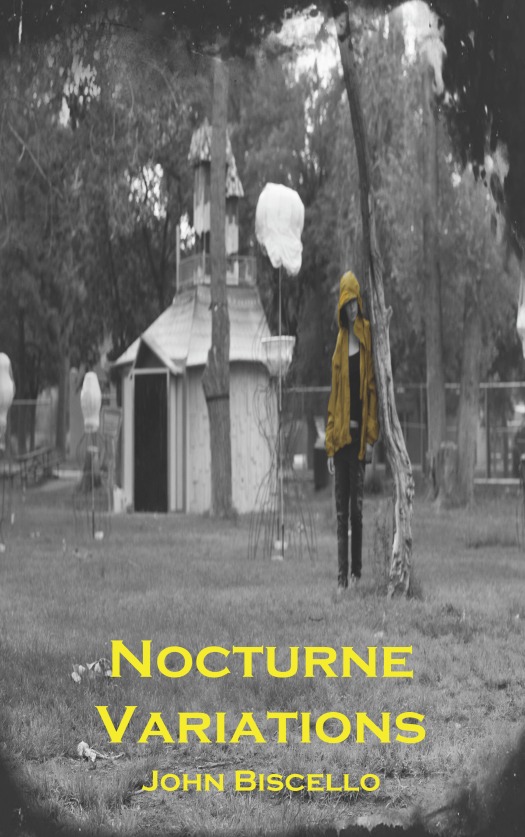
Nocturne Variations is a twenty-first century presentation of avant-garde literature.
Super. But what is avant-garde? Avant-garde is a French term that means advance guard; people and ideas that are ahead of their time. It’s a concept that refers to artists, composers, and writers whose works oppose mainstream values. As a noun, avant-garde is defined as new and unusual or experimental ideas in the arts. Often connected to political activism (think of Theater of the Absurd, Bob Dylan, and John and Yoko), there exists a misconception that avant-garde must always be politically driven.
Regarding visual art, it’s of popular thought that the avant-garde movement began in the mid-nineteenth century with French painter Gustave Courbet and his astonishing gift for realism. A notable example of Courbet’s opposite is fellow modernist Salvador Dali, the Spanish surrealist who created The Persistence of Memory. Courbet and Dali differ in style and perception, but their works are equally avant-garde.
That’s all good to know, but we’re supposed to be talking fiction. So, what are some examples of avant-garde literature? Literary experts go bananas over James Joyce’s Ulysses; first published in 1922, this epic is best known for its stream-of-consciousness style. Another disturbance to convention was T.S. Eliot’s publication of The Waste Land, a poem that obliterated traditional form and ideals. 1922 had proven to be a formative year in the writing world. Thanks to writers such as Joyce and Eliot, we saw the influence of the modernist movement flourish in the works of Virginia Woolf, Ezra Pound, and ee cummings.
Fast-forward to post-modernism: radical novelists like George Orwell and Anthony Burgess, and the experimental poets of the Beat Generation continued to revolutionize written expression. In the twenty-first century, however, avant-garde literature, or experimental fiction—whatever you prefer to call it—has become rather familiar. We’re living in an age so saturated with uniqueness, it’s a challenge to produce anything that is not derivative.
Enter John Biscello.
Nocturne Variations is the tale of young Piers, a runaway, huffing enthusiast, and doyen of shadow puppetry. Within the pages, Biscello has created a kind of dystopian subculture where the illusory and the palpable breathe equal air; he’s built a world where even the shadows have distinct voices, and philosophy and folklore weigh the same.
“Of course the Neverlands vary a good deal.”
― J.M. Barrie, Peter Pan
Welcome to Tabanid, the L.A. vaudeville nightclub where dark and lascivious characters come alive. We meet our protagonist in the coat closet, engaged in a tryst just as she’s due to take the stage. One develops an opinion of Piers straightaway; seemingly carefree and wild-hearted, what Piers may lack in savoir faire, she makes up for with an offbeat kind of charm. The camaraderie between Piers and her shiny shadow partner, Trink, endears her even more—as an observer, it may be easy for readers to overlook Piers’ addictions in the beginning.
The world in which Piers subsists is a cruel one, and not unlike our own. She is often confronted by a monster called childhood trauma, as well as the devastating knowledge that she isn’t who she is supposed to be. As her story progresses, the spiritual theme presents itself organically through her musings, self-reflection, and interactions. Yes, we learn a great deal about Piers when she must run away from L.A. We also discover that this world can be a kind and forgiving one, not unlike our own; for in the old coal-mining town of Redline, there exists a new life path awaiting Piers.
It takes the relationships that Piers develops with Henry Hook and Gwen to reveal Piers’ actual nature. Once the enlightenment hits, you realize you’re not only an observer; you realize that you want to take care of this tragical shadow being.
“Wait for me somewhere between reality and all we’ve ever dreamed.”
—J.M. Barrie, Peter Pan
Nocturne Variations includes an arrangement of features that one might consider too ambitious. On the contrary, these pieces intermingle with the narrative quite naturally. Poems; diary entries; newspaper excerpts; interviews; notable quotes; and notes on cinema all operate as single vehicles with a shared destination. This composite not only makes odd sense, but it excites.
Biscello’s command of dialogue interested me because of the unusual structure, and I’d quickly decided that standard formation would have only disrupted the story’s distinctive movement. This novel is proof that he is one of the great visionary authors of today. He impresses with his employment of unconventional construction, multiple points of view, and cinematic scene direction without sacrificing a single thread of the human element.
Simply put, this novel is bold in design and syntax. As an author, ravenous reader, cinephile, and lover of art, I challenge anyone to argue that John Biscello’s Nocturne Variations does not qualify as both avant-garde literature and multimedia artwork.
Nocturne Variations releases on 30 November, 2018, and is available for pre-order on Amazon.

 Indie Blu(e) Publishing