Originally posted on Sudden Denouement Literary Collective
I am not a poet. Occasionally, I write poetry and find myself feeling defeated, throwing the words back into the void, resigning myself to writing short, personal narratives. I have, no doubt, come to terms with my shortcomings as a poet, which perhaps informs my deep respect for those who have earned the sacred title. There is something inherently special about a person who possesses a power over words, bending them to their will, plucking beauty out of the dust of time, creating concise explanations of their relationship to the universe with ease and grace. Some poets, the special ones, are privy to the secret language, part of a sacred tribe whose words contain clues to the mystery of life. These are the ones who inspire me. My life has been altered by poets from a young age, and I continue to seek new voices, finding myself stunned and mesmerized as I find new writers who meet the criteria of tapping into an emotional place reserved for those with the sanctified tongue. This is the context in which I find the work of Melissa Studdard.
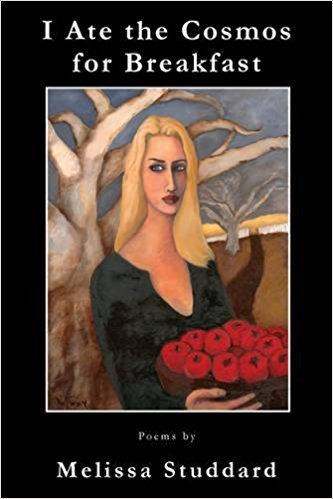
For my second Sudden Denouement book review, I sought out a book of poetry, preferably written by a Houston writer. Several writers suggested Melissa Studdard and her first book of poetry I Ate the Cosmos for Breakfast [Saint Julian Press 2014]. I quickly discovered that the connotation of a Houston poet was not appropriate when addressing the work of Studdard. She had previously established herself as a fiction writer with her book, Six Weeks to Yehidah, which earned her awards and acclaim. The depth of the poetry in Cosmos solidifies her place as much more than a regional poet. Percy Shelley described poetry as such: “Poetry is a sword of lightning, ever unsheathed, which consumes the scabbard that would contain it.” This powerful definition describes the energy with which Studdard writes. She writes poetry where she dances and consumes worlds, co-existing with God, as illustrated in “Nirvana:”
There’s no mother’s milk
the second time around,
just a crescent moon
floating in a goblet bigger
than your own head, or maybe
it’s really the world in the there,
shimmering and dark,
ready to be consumed.(pg. 4)
Throughout her work, the reader is given glimpses of the universe rolled into everyday life. She finds God “on a head of wheat” in the title poem. While in “Naming Sky,” she finds a temple, along with “voices lingering in the trees” which can be called “God or sky or self.” Studdard interacts with nature, the self, and cosmos in her work. In “Creation Myth,” she describes God as she brings the world from her womb, the process explained with keen, poetic vision:
So there God lay, with her legs splayed,
birthing this screaming world
from her red velvet cleft, her thighs
cut holy with love
for all things, both big and small,
that crept from her womb like an army
of ants on a sugar-coated thoroughfare.
It wasn’t just pebbles and boulders…(pg. 3)
Effortlessly she navigates the world between mundane and spiritual life. She uses her “sword of lighting” to carve out her own mythology, born out of her own experience and understanding, refined with her exquisite, concise language.
The book I Ate the Cosmos for Breakfast establishes Studdard as a poet of the highest order. She displays her understanding of the craft, while she composes her beautiful songs that are at times powerful, and other times quiet. Her work demonstrates great diversity and depth of articulation. In a sea of poetry flooding the internet, one may ask why the work of Studdard is special? My answer is that her work is touched, possessing the power of soul-stirring words not found readily among the thousands of poets baring their souls daily on the numerous writing sites. Her poetry is stunning. She has a distinct and a powerful voice which invokes the same excitement I had as a teenager discovering a variety of works from Arthur Rimbaud to Lawrence Ferlinghetti. She has earned a place on the printed page, packaged in a tangible way which lends itself to having the pages felt as one makes the journey into Studdard’s mythology. I read too much, perhaps I am jaded. My eyes grow weary of mediocre work. This book finds my attention, washes the mediocrity away as I peel back the layers of her poetry . Melissa Studdard has earned the title that so many seek: she is a without a doubt a POET!

[Photo: Clara Bow]
Five Questions for Melissa Studdard: An Interview by Jasper Kerkau
Jasper Kerkau: It seems a natural inclination to pluck out influences from a writer’s work. I discovered Reality Sandwiches by Allen Ginsberg at seventeen years old, and my life was never the same. In your work, Starry Night, with Socks, you write: “Neruda eats gates and barbed wire, absorbs the nails and exhales a borderless world.” Is there a debt of gratitude to be paid to Pablo Neruda in your work? If not Neruda, what writers had a tremendous impact on you and how did they influence your work?
Melissa Studdard: Absolutely yes—I owe Neruda! It’s complex, though. For years I was in love with his work. I studied it the way you’d study the face of someone you love—from every angle, in every kind of light. Because I conflated the work with the man, I thought I loved Neruda too. I mean, he was a diplomat, after all.
But about a year ago, I discovered a passage in his memoir that disturbed me. He’d basically “taken” a Tamil woman despite her disinterest. Further, he glorified it with a romanticized “hard-to-get” description.
In some cases, I can separate the work from the person, but here it was impossible. The passage was written towards the end of his life, and the poetic thinking was interwoven with the incident. How could I trust his language, descriptions, and ideas after that? I’m just starting to get my mind around it all. I still feel the way I always did about my favorites of his poems, but I don’t feel the same way about him overall.
Off the top of my head, other writers and artists I love are Muriel Rukeyser, Audre Lorde, Anne Sexton, Li-Young Lee, Remedios Varo, Leonora Carrington, Gabriel García Márquez, Yehuda Amichai, and Lucille Clifton. I’m sure there are about a hundred more. As you can see, I tend towards the highly imaginative and figuratively dense.
JK: I had a moment when I decided I would not allow my vocation to define my existence; rather, I would begin to identify myself as a writer. Was there a moment for you where you proclaimed to the world “I am a writer”?
MS: I think my rite of passage was more about claiming time than proclaiming an identity. As a divorced, working parent, it’s been hard over the years to find time to write. So, rather than a specific moment or proclamation, there was a shift that took place over a several year period—a shift in which I sifted out senseless, rote chores and seized the hours back for writing. It felt like a hostile takeover at first, but people got used to it. Now, I block out writing time on my calendar every week, just the way I block out my class periods. I take great care not to schedule anything during that time that is not so important I would not also cancel a class for it. This is possibly the most important thing I have done for my writing—simply prioritizing it in my life.
JK: Often new writers will rush works. In your interview with Catherine Lu of Houston Public Media, you state that the poem “Daughter” was incubating for years before it took form on paper. When you actually put a poem on paper, how much time do you spend revising it before you feel it is ready for public consumption?
MS: One of the most crazy, delightful, gorgeous things about writing is that many aspects of its process remain mysterious even to those who practice it. Though there are some constants, the overall process is not static, and no matter how much I write I don’t fully know what to expect when I sit down to a new piece. There are poems I’ve written in fifteen minutes, with no revision, and there are poems that have taken years to conceptualize and months to revise. And there are many, many poems I’ve thrown out altogether. Sometimes they just don’t work, and that is something to recognize too.
I think the best way to know when something is done, or as you put it, fit “for public consumption,” is to put it away for a week or more and then look at it with fresh eyes. It’s best if you’ve written or are writing something else that you’re excited about in the meantime so that you’re no longer infatuated with the piece you’re about to revise. When you’re excited about a new piece it becomes easy to admit and fix flaws in the previous piece because your ego is not all tied up in it anymore. You know you’re fabulous because you have just written something new that you’re still high on. This is my cycle—working on a new piece, revising another.
JK: How much of a labor of love was publishing I Ate the Cosmos for Breakfast, and how did that process compare with getting Six Weeks to Yehidah in print?
MS: I was lucky to place both books with small presses run by great people. Both Saint Julian Press (I Ate the Cosmos for Breakfast) and All Things That Matter Press (Six Weeks to Yehidah) took great care with the process, making sure to consult me about creative issues, such as design and cover, while handling the labor themselves. Both publishers also offered invaluable editing help and revision suggestions without ever pushing me to make changes. If I did ever feel that I was caged inside a labor of love, it was only at the editing stage, once we were past revision and working to agree on commas and semi-colons and that sort of thing. And don’t even get me started on lie/lay/laid/lain. There were a couple of times I felt like just saying, “Do whatever you want to it. See you on the other side.”
JK: I spend a lot of time talking to writers, and many times there is a conflict with the universe that is being worked out. Your work is replete with spiritual overtones. The poem “Integrating the Shadow” is a playful poem that touches on spiritual duality. Are you at peace with universe? And if so, how did this book help that process?
MS: Mostly, I am at peace. But you nailed the duality issue.
I have a hyperactive superego, as well as a hyperactive id—so oftentimes there are two distinctly opposing choices that feel “right” in different ways—my parent/society/conservative voice tells me one thing, LOUDLY, and my wild, true inner voice urges something else. You can see how this sets me up for failure and guilty feelings. No matter which choice I make, I’m disappointing myself by not making the other one.
Whereas peace asks us to float in its currents, I often swim at an angle alongside it, feeling guilty. Then I feel guilty for feeling guilty. Guilt is my beef with the universe, my parasite, my one true illness. I can’t help but feel that if I could cleanse myself of it I would be at peace fulltime instead of a peace adjunct.
But yes—writing helps. With writing I can explore my duality, guilt, and other concerns with humor and love. I can see my guilt for what it is—a distraction. And I can put my attention back where it should be—on caring for others and making art.
Bio
Melissa Studdard’s debut poetry collection, I Ate the Cosmos for Breakfast, was recently released by Saint Julian Press. She is also the author of the bestselling novel Six Weeks to Yehidah; its companion journal, My Yehidah(both on All Things That Matter Press); and The Tiferet Talk Interviews. Her awards include the Forward National Literature Award, the International Book Award, the Readers’ Favorite Award, and two Pinnacle Book Achievement Awards. As well, I Ate the Cosmos for Breakfast was listed as one of Cutthroat: A Journal of the Arts‘ Best Books of 2014-2015.
Melissa’s poetry, fiction, essays, reviews, and articles have appeared in dozens of journals, magazines, blogs, and anthologies, including Tupelo Quarterly, Psychology Today, Connecticut Review, Pleiades, and Poets & Writers. In addition to writing, Melissa serves as the host of VIDA Voices & Views and an editor for American Microreviews and Interviews. She received her MFA from Sarah Lawrence college and is a professor for the Lone Star College System and a teaching artist for The Rooster Moans Poetry Cooperative.
[Jasper Kerkau has created and written for numerous websites. He is a writer/editor for Sudden Denouement. His works are cataloged on his newest site
Jasper Kerkau Writing.]



 Indie Blu(e) Publishing